Kia Rio (2011–2023) Review for Young Drivers: Insurance, Running Costs and the Best Generation to Buy
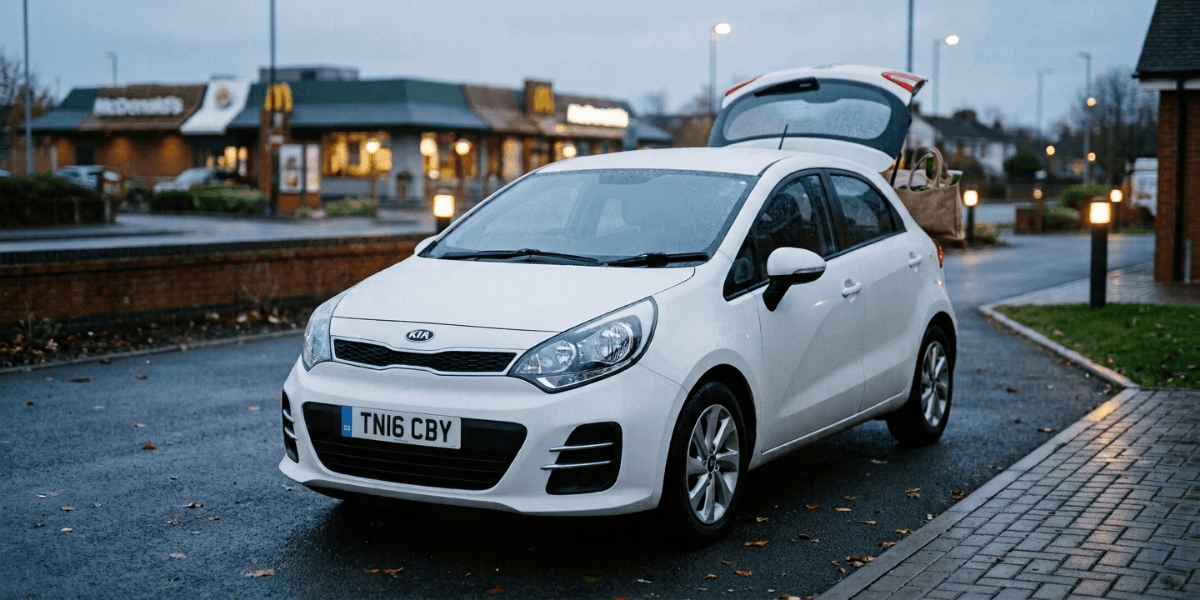
The wrap
The Kia Rio is one of the most insurable first cars on the UK used market but not many people know about them. They're a good value and well made, Fiesta-sized hatchback. The Mk3 1.1 CRDi is the lowest possible Insurance Group 1. The Mk3 1.25 MPI is in Groups 3 to 5 and the newer Mk4 1.25 DPi is only Group 4. It has a good 325 litre boot (bigger than a Fiesta or a Corsa), Kia's seven year 100,000 mile warranty and a 49.5 mpg real-world average on the naturally aspirated petrol. The Rio is a good choice.
On the downside, the cheapest Group 1 trim is a diesel, which isn't good for short journeys. And the base Mk4 with no Advanced Driving Assistance Pack only scored 3 stars on Euro NCAP. Pick the right engine and trim and the Rio is one of the most sensible first cars in the country.
Quick facts
| Metric | Value |
|---|---|
| Generations covered | Mk3 (2011–2017), Mk4 (2017–2023) |
| Insurance Groups | 1–9 depending on engine and trim |
| Used price range | £2,500–£12,000 |
| Euro NCAP | 5 stars (Mk4 with ADAP, 2017 test); 3 stars (Mk4 base, 2017 test); 5 stars (Mk3, 2011 test) |
| Best engine for new drivers | 1.25 MPI / DPi 83PS, Insurance Group 3–5 |
| Annual road tax | £20–£195 (Mk3, based on CO2); £195 flat rate (most Mk4s) |
| Est. annual running cost | £2,300–£3,800 for a 17–21 year old with a telematics policy |
| Common issues | Air conditioning compressor, TCM hesitation (automatic), MAF sensor stalling, DPF blockage on diesels, fuel pressure issues on high mileage CRDi |
| Warranty | 7 year / 100,000 mile transferable (original first registration date) |
Insurance groups sourced from ABI/Thatcham Research. Running costs estimated for a 17–21 year old with a black box policy.
Who is this car for?
The Rio is great for a new driver with a tight budget looking for the cheapest insurance on a Fiesta sized car and the peace of mind of a long warranty.
Perfect for:
- 17 to 19 year olds where insurance is the main budget concern
- Drivers with 'stuff' who want a 325 litre boot (more than the Fiesta's 292 or the Corsa's 267)
- Buyers who value mechanical simplicity over being fun to drive
Not ideal for:
- Anyone prioritising a fun drive. The Fiesta, Ibiza and Polo drive better.
- Short-trip urban drivers looking at the 1.1 or 1.4 CRDi diesels. Stop-start journeys aren't good with diesels.
- Anyone wanting a high-tech interior. The cabin is dark plastic and the screen is functional, not flashy.
For low emission zone considerations with older Rio diesel models, read our UK low emission zones for young drivers guide.
The two generations: Mk3 vs Mk4
There are two Kia Rio generations that show up on the UK used market as realistic first cars. The Mk3 is cheaper and the Mk4 is safer.
| Mk3 (2011–2017) | Mk4 (2017–2023) | |
|---|---|---|
| Platform | Kia UB | Kia/Hyundai B-segment |
| Typical used price | £2,500–£6,500 | £6,000–£12,000 |
| Best engine | 1.25 MPI 83PS | 1.25 DPi 83PS |
| Insurance Group range | 1–9 | 4–8 |
| Boot space | 288 litres | 325 litres |
| Euro NCAP | 5★ (2011 test) | 5★ with ADAP / 3★ without (2017 test) |
| AEB as standard | No | Trim '2' and above |
| Apple CarPlay | No | Trim '2' and above |
| Body styles | 3-door, 5-door | 5-door only |
| Warranty status | Expired | Some examples still covered to 2026 |
The Mk4 is the more complete first car: bigger boot, better tech, AEB on higher specs and nicer to drive. The Mk3 is the one to go for if your budget is sub-£5,000.
Driving and performance
Mk3 (2011–2017)
The Mk3 was engineered for practicality and economy, not driving fun. The steering is light, the gearchange is nice and the chassis pushes into safe, manageable understeer when pushed. Auto Express called it “a safe pair of hands” and it is.
The engine line-up to consider as a first car:
- 1.25 MPI 83PS petrol: Group 3–5, no turbo, 49.5 mpg real-world. The first car pick.
- 1.1 CRDi 74PS diesel: Group 1 or 3 depending on trim, 66 mpg real-world. Sounds great on paper. Wrong car for short urban journeys (see DPF section below).
- 1.4 MPI / 1.4 CRDi: Insurance jumps to Groups 7 to 9. Not worth the running cost increase for new drivers.
The 1.1 CRDi takes around 15 seconds to reach 60 mph. That sluggishness keeps insurance cheap but it's a pain for busy motorway merging. Carwow's verdict on the engine line-up was blunt: the 1.25 petrol “isn't fast, but it does the job”.
Mk4 (2017–2023)
A clear step up in refinement and chassis composure. The cabin is quieter at speed, the seats are better and the dashboard layout looks modern.
Engine options relevant for new drivers:
- 1.25 DPi 83PS petrol: Group 4, no turbo, around 49 mpg real-world. The Mk4 insurance hero.
- 1.0 T-GDi 100PS / 120PS petrol: Group 8. More torque for motorway work, real-world economy is around 43 mpg (a 14% drop on the official figure) and the insurance group climbs significantly.
- 1.4 CRDi 89PS diesel: Group 7 to 8. Same DPF concerns as the Mk3 diesels.
"A perfectly reasonable car for people who aren't interested in cars."
The 1.25 DPi 83PS is the safer first car call. The 1.0 T-GDi is only worth it if motorway commuting is part of the daily routine and there's room in the insurance budget for the Group 8 jump.
Technology and interior
Mk3 (2011–2017)
Basic radio on the entry trim, a small colour screen on higher trims. No CarPlay, no Android Auto. The dashboard is dark hard plastic and aged quickly. Mid-life 'VR7' trims got an upgrade to a colour screen with reversing camera. For smartphone integration on a Mk3 the answer is an aftermarket unit, around £150–£250 fitted.
The 288 litre boot is larger than a Fiesta of the same era. Rear head and legroom is fine for two adults. Three across the back is tight.
Mk4 (2017–2023)
This is where the Rio starts to feel more modern. From the '2' trim upwards the Mk4 ships with a 7-inch touchscreen, Apple CarPlay, Android Auto and Bluetooth as standard. The screen sits high on the dashboard which keeps the driver's eyes closer to the road. Top Gear noted the layout is “more intuitive than most of its rivals”.
The 325 litre boot is bigger than the Ford Fiesta (292 litres) and the Vauxhall Corsa (267 litres) of the same period. Only the corporate cousin Hyundai i20 (352 litres) beats it in the class. Folded down, the Mk4 expands to 1,103 litres.
Interior materials are durable rather than plush. The flip side is the cabin holds up well over time, which is the right priority for a six year old £8,000 first car.
Safety
Mk3 (2011–2017)
5 star Euro NCAP rating from the 2011 test. ABS, ESC, six airbags and ISOFIX on the outer rear seats are standard. There's no AEB, no Lane Departure Warning and no autonomous safety tech. By 2026 standards the Mk3 is a good passive structure with no active safety.
Mk4 (2017–2023)
Trim selection has an impact on safety scores due to the optional autonomous braking. Mk4 Rio in base '1' trim scored 3 stars on Euro NCAP. With the Advanced Driving Assistance Pack (ADAP) fitted (standard from trim '2' upwards in the UK), the same car scored the maximum 5 stars.
| Euro NCAP category | Base '1' trim | '2' trim and above (ADAP) |
|---|---|---|
| Overall rating | 3 stars | 5 stars |
| Adult occupant | 85% | 93% |
| Child occupant | 84% | 84% |
| Vulnerable road users | 62% | 71% |
| Safety assist | 25% | 59% |
The ADAP pack includes Autonomous Emergency Braking (AEB), Lane Departure Warning (LDWS) and Driver Attention Alert. AEB uses a forward facing camera and radar to brake the car if the driver doesn't react in time. Euro NCAP data shows AEB cuts rear-end collisions by around 38%.
For a Mk4 Rio, the rule is simple: buy a '2' or above. Never buy a '1' as a first car. The £500–£1,000 saving on the base trim is not worth giving up the 5 star rating and AEB.
Vehicle Stability Management (VSM), Hill-start Assist Control (HAC) and Electronic Stability Control (ESC) are standard across the Mk4 range.
The new Vehicle Risk Rating (VRR) system
The UK insurance industry is moving from the legacy 1–50 ABI insurance group system to Thatcham's new Vehicle Risk Rating (VRR) system, with full transition through 2026. VRR scores cars on five pillars: Performance, Damageability, Repairability, Safety and Security. The Rio's combination of modest performance, simple body panels and (on '2' and above) AEB is projected to keep it among the lowest VRR scores in the class.
For a plain English explanation of how groups translate into quotes, read our car insurance groups explained guide.
Running costs and ownership
Insurance
This is the main reason to buy a Kia Rio as a first car. The Group 1 and Group 3 to 5 options are some of the lowest insurance groups on the entire UK market.
| Generation | Engine / trim | Insurance Group |
|---|---|---|
| Mk3 (post-01/2015) | 1.1 CRDi '1 Air' | 1 |
| Mk3 (post-01/2015) | 1.1 CRDi '1' | 2 |
| Mk3 (2011–2017) | 1.25 MPI '1' | 3 |
| Mk3 (2011–2017) | 1.25 MPI '2' | 4–5 |
| Mk4 (2017–2023) | 1.25 DPi '2' | 4 |
| Mk4 (2017–2023) | 1.4 CRDi '3' | 7–8 |
| Mk4 (2017–2023) | 1.0 T-GDi '3' | 8 |
Finder UK data puts the average annual premium for a 20 year old on a Group 2 Rio at £766, vs £837 for a Group 8 Rio. That £70 a year gap looks small on paper, but the jump from Group 4 to Group 8 in practice often doubles the actual quote because insurers stack their own loadings on top of the group classification. Pair a Group 4 1.25 DPi Mk4 with a telematics policy and the first year quote becomes manageable.
For a deeper look at telematics options, see our telematics insurance explained guide.
Fuel economy
| Engine | Real-world combined mpg |
|---|---|
| 1.25 MPI / DPi (Mk3 & Mk4) | 49–50 mpg |
| 1.4 MPI (Mk3) | 47–49 mpg |
| 1.0 T-GDi (Mk4) | 42–44 mpg |
| 1.1 CRDi (Mk3) | 60–66 mpg |
| 1.4 CRDi (Mk3 / Mk4) | 55–59 mpg |
The 1.25 petrol's real-world figure almost exactly matches the official figure, which is unusual in this class. The 1.0 T-GDi turbo only hits 86% of its claimed mpg when driven normally and drops further when an inexperienced driver gets keen with the throttle.
Road tax
The April 2017 VED reform splits the Rio range cleanly:
- Pre-April 2017 (Mk3): Taxed on CO2 emissions. A 1.1 CRDi EcoDynamics qualifies for £0–£20 a year. A 1.25 petrol sits at £30–£135 a year depending on registration year and CO2.
- Post-April 2017 (most Mk4s): Flat £195 a year (2025/26 rate) regardless of engine. The 48V mild hybrid T-GDi qualifies for a £10 alternative fuel discount.
Budget the £195 figure for any Mk4 purchase. The Mk3 tax saving works out at £800–£900 over a five year ownership window if the buyer picks a low-CO2 example.
Servicing
The Rio shares parts with the Hyundai i20, the Kia Stonic and the Kia Picanto, so any independent garage can work on it and parts are widely available.
| Service | Independent garage | Kia main dealer |
|---|---|---|
| Minor (oil and filter) | £90–£140 | £210 |
| Full | £180–£280 | £390 |
| Front brake pads (fitted) | £80–£120 | £180 |
| Cambelt or chain change | Chain on 1.25 (no change) / £450–£600 on 1.1 CRDi | £750+ |
| Air con compressor replacement | £450–£700 | £900+ |
The 1.25 MPI/DPi runs a timing chain that doesn't need scheduled replacement, which is one less liability over the ownership window. The 1.1 CRDi diesel runs a belt that needs replacing around 90,000 miles.
Annual running cost (17 to 21 year old)
| Cost item | Mk3 1.25 MPI | Mk4 1.25 DPi '2' | Mk4 1.0 T-GDi '3' |
|---|---|---|---|
| Insurance (with telematics) | £1,200–£1,600 | £1,300–£1,700 | £1,800–£2,400 |
| Fuel (8,000 miles) | £900 | £900 | £1,000 |
| Road tax | £30–£135 | £195 | £195 |
| Servicing | £150–£250 | £200–£300 | £200–£300 |
| Total | £2,280–£2,885 | £2,595–£3,095 | £3,195–£3,895 |
The Mk4 1.25 DPi often works out as the cheapest car to own year one once you factor in the lower repair risk from the remaining warranty.
What to watch: known issues
Air conditioning compressor failure (all generations)
Documented across both Mk3 and Mk4 Rios. Symptoms: warm air from the vents, vibration from the engine bay when the AC is engaged, or a knocking noise on the compressor pulley. Cause is usually a failed compressor clutch or a refrigerant leak. Repair is £450–£700 at an independent. Always test the air conditioning thoroughly on a viewing, including how quickly the windscreen clears on demist.
Diesel Particulate Filter (DPF) blockage on 1.1 and 1.4 CRDi
The main reason to avoid the diesel as a first car if it's mainly used for short journeys. DPFs need sustained high temperature running to clear the soot they capture. Short stop-start journeys (the classic young driver pattern: school run, college, supermarket) don't get the exhaust hot enough. The DPF clogs, the engine derates, and the dashboard lights up. A forced regen at a garage is £200–£400. A full DPF replacement is £1,500–£2,000+. Walk away from any CRDi Rio that's lived on short urban journeys.
Mass Air Flow (MAF) sensor and ignition coil stalling (1.25 petrol)
Naturally aspirated petrol Rios occasionally stall or hesitate on throttle application. Diagnostic checks usually point to a fouled MAF sensor, a worn ignition coil or a carbon-clogged throttle body. Parts are cheap (MAF sensor £40–£80, coil pack £30–£60), labour is straightforward. Left alone, the car will fail an MOT on emissions.
Transmission Control Module hesitation (automatic Mk4)
Automatic Mk4 Rios have a documented pattern of hard shifts or hesitation between gears. The cause is usually electronic (TCM software, degraded transmission fluid) rather than mechanical, but diagnostics and a flush cost £200–£400. Most Rios are manuals, which is what new drivers should be buying anyway. If considering an automatic, do a thorough test drive at varied speeds and ask for proof of any transmission fluid changes.
High pressure fuel system on high-mileage CRDi diesels
On Mk3 and Mk4 CRDi engines past 80,000 miles, there are documented cases of high pressure fuel pump failures and injector leak-off issues. Repair bills run from £600 for a single injector to £1,800+ for a pump. Another reason to leave the diesel for a higher mileage owner with a long motorway commute.
Boot lock and tailgate corrosion
Less catastrophic than the AC compressor but worth checking on any Mk3 over six years old. The tailgate lock and the rear number plate light housing are common rust starting points. Check the seam under the rear wiper and around the tailgate handle.
MOT watch points
DVSA MOT data flags the Kia Rio's most common failure categories as lighting (blown bulbs, headlamp aim), suspension components (drop links, anti-roll bar bushes) and brakes (worn pads or discs missed at service). None are serious. A five minute walkaround before the MOT clears most of the lighting flags.
Viewing checklist
- Start the engine cold and listen for any tapping, knocking or the AC compressor noise
- Switch the AC on within the first minute of the test drive and check it cools properly
- Check the Government MOT history online before the viewing for repeat advisories
- For any CRDi diesel, look at the service history and ask explicitly about journey patterns
- For Mk4 cars in '2' trim or above, confirm the ADAP / AEB camera in the windscreen is intact and not flagging warnings
- For automatics, do a slow speed crawl and a 30 to 50 mph kickdown to check shift quality
- Check the warranty status on the Kia website by registration number (Mk4 cars first registered after May 2019 may still be covered)
For a proper pre-purchase inspection routine, see our used car inspection guide for young drivers.
The best variant to buy
The safe bet: newly qualified 17 to 19 year old
2018–2021 Mk4 Rio '2' in 1.25 DPi 83PS. Insurance Group 4, AEB and Lane Departure Warning standard, Apple CarPlay, 5 star Euro NCAP, 325 litre boot. The remaining seven year warranty is the insurance policy on top of the insurance policy. Budget £7,000–£9,500 with a clean service history.
For a 19 to 21 year old with one year of no-claims
2019–2022 Mk4 Rio '3' in 1.0 T-GDi 100PS. Group 8, sixth gear, more relaxed motorway driving, better mid-range torque. Budget £8,500–£11,500. The Group 8 insurance step is the price of motorway comfort.
Budget pick (£3,500–£5,500)
Mk3 Rio '2' or 'VR7' in 1.25 MPI 83PS. Group 3–5 insurance, 5 star Euro NCAP from 2011, the cheap-to-fix petrol engine. The trade-off is no active safety tech and an aged cabin. For a town based first year of driving, it's a sensible buy.
The Group 1 insurance hero (with a caveat)
Post-2015 Mk3 Rio '1 Air' in 1.1 CRDi 74PS. Insurance Group 1, 66 mpg real-world, £20 road tax. The cheapest Rio to insure on the entire UK market. Only buy this car if the driver has a regular motorway journey or A-road commute. Short urban journeys will destroy the DPF and the savings on insurance will be wiped out by a £1,500+ repair bill.
Avoid
- Mk4 Rio in base '1' trim (3 star Euro NCAP, no AEB)
- Any CRDi diesel where the previous owner's pattern was short urban journeys
- Any Mk4 automatic without proof of regular transmission service
- High mileage (90,000+) CRDi diesels without a recent fuel system inspection
See our best first cars under £3,000 guide if budget is the hard constraint and the Mk3 Rio is the stretch.
The verdict
The Kia Rio is the rational choice for a first car. It doesn't drive as well as a Ford Fiesta. It doesn't feel as sharp as a SEAT Ibiza. The interior is a step behind a Skoda Fabia of the same era. But on the two metrics that dominate a first year budget, insurance and reliability, the Rio is one of the strongest cars in the supermini class.
Kia discontinued the Rio in late 2023 to focus on SUVs and EVs. The used Rio market has held firm because there isn't a cheaper new alternative arriving to replace it. Parts supply is fine. The Rio shares mechanicals with the Hyundai i20, the Kia Stonic and the Kia Picanto, and the global parts ecosystem behind those three cars is secure into the 2030s.
The Mk4 '2' in 1.25 DPi is the overall top recommendation. Group 4 insurance, AEB standard, 5 star Euro NCAP, 325 litre boot, the remaining seven year warranty as a financial safety net. For a 17 year old who needs the lowest possible total cost of year one ownership, it's a serious contender against the SEAT Ibiza MPI and the Volkswagen Polo base trim.
Pros
- Insurance Group 1 to 4 on the right engine and trim, among the lowest in the class
- 325 litre boot bigger than the Fiesta or Corsa of the same era
- Seven year / 100,000 mile transferable warranty (still active on later Mk4s)
- 1.25 MPI/DPi runs a timing chain, not a belt: one less scheduled repair
- 5 star Euro NCAP on Mk4 '2' trim and above, with AEB standard
- 49.5 mpg real-world on the 1.25 petrol, almost exactly the claimed figure
- Parts and servicing widely available through the Hyundai/Kia ecosystem
Cons
- Mk4 base '1' trim is only 3 star Euro NCAP with no AEB: avoid
- 1.0 T-GDi turbo achieves only 86% of its claimed mpg in real-world use
- CRDi diesels carry meaningful DPF blockage risk for short-trip urban drivers
- Interior plastics are durable but feel cheap next to a Polo or a Fabia
- Steering is light and numb at motorway speeds: stable, not engaging
- Automatic gearbox has documented TCM hesitation issues
Final word
The one to buy: 2018–2021 Mk4 Rio '2' in 1.25 DPi 83PS, clean service history, AEB camera working.
Also worth reading before you decide: our SEAT Ibiza review and Hyundai i20 review cover the Rio's two closest used-market rivals. The i20 in particular shares the Rio's underlying mechanics and is worth a direct comparison.