Ford Fiesta (2008-2023) Review for Young Drivers: Still the Best First Car?
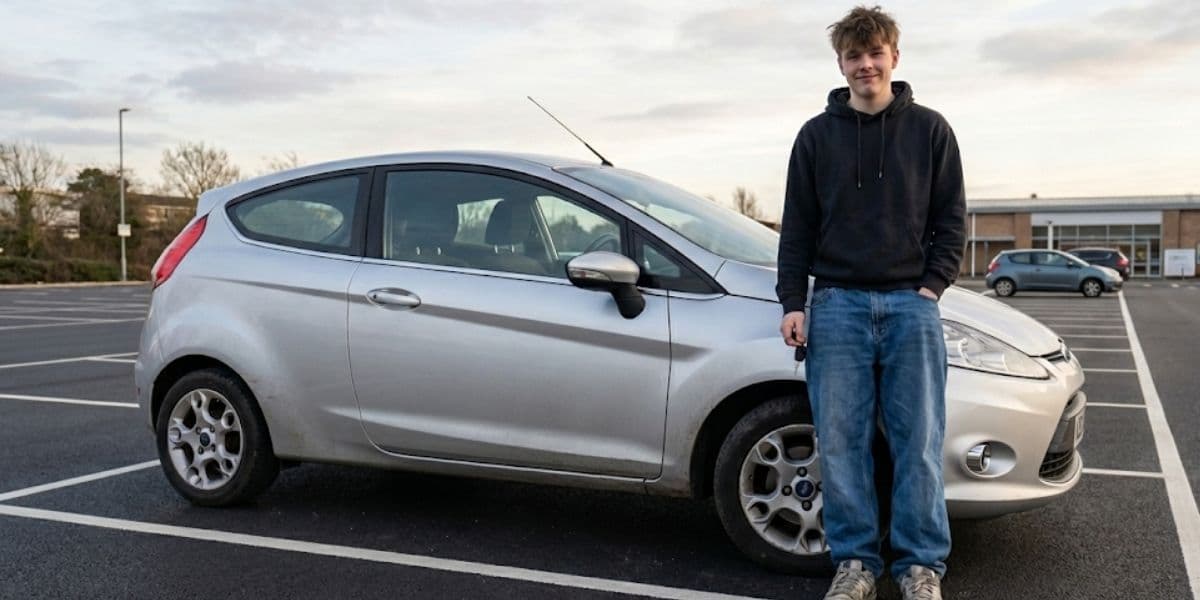
The wrap
The Ford Fiesta is still one of the best first cars in 2026 thanks to low insurance groups (2-6 for the non-turbo engines), class leading handling and a huge used market offering great choice. The 1.0 EcoBoost is a brilliant engine to drive, but the wet timing belt is a serious reliability risk that can write off the car entirely. For peace of mind, stick to the non-turbo engines: the 1.1 Ti-VCT on the Mk8 or the 1.25-litre on the Mk7.
Quick facts
| Metric | Value |
|---|---|
| Insurance Groups | 2-30 (2-6 for young driver engines) |
| Used Price Range | £2,500-£15,000 |
| Euro NCAP | 5 stars (Mk7: 2012 test, Mk8: 2017 test) |
| Best Engine | 1.1 Ti-VCT 75PS (Mk8) or 1.25 Duratec (Mk7) |
| Annual Running Cost | £3,900 (17yo), £2,700 (21yo) |
Who is this car for?
The Fiesta is bigger than a lot of first driver cars so works for most people.
Perfect for:
- Parents buying their teen's first car with a £4,000-£12,000 budget
- Young drivers doing a mix of city, A-road and motorway driving
- Teens who care about how the car drives (it's great fun)
Not ideal for:
- Tall rear passengers (rear headroom is tight for 6'2"+)
- If you need a large boot (292L is ok but not class leading)
- Anyone who needs an automatic (Powershift gearbox has known issues)
The Fiesta is versatile. It's small enough for city parking but stable enough for motorway driving. The handling is sharp enough that experienced drivers enjoy the car and for a new driver learning car control, the Fiesta responds predictably. That builds confidence faster than something vague or numb.
The used market is massive. Production ran from 2008 to 2023, covering two generations (Mk7 and Mk8), so there are thousands of examples at every price point. Don't settle for the first Fiesta you see.
The two generations: Mk7 vs Mk8
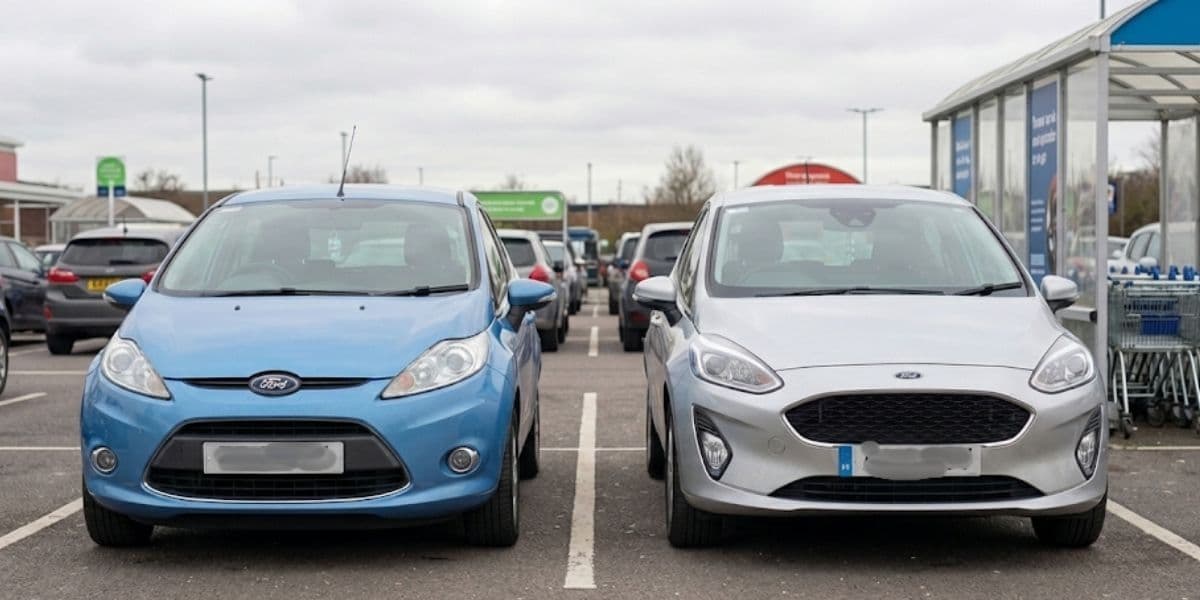
Before diving into the detail, here's what separates the two generations. Both are excellent first cars, but they suit different budgets and priorities.
| Feature | Mk7 (2008-2017) | Mk8 (2017-2023) |
|---|---|---|
| Best engine for young drivers | 1.25 Duratec 80bhp | 1.1 Ti-VCT 75bhp |
| Insurance groups (safe engines) | Group 2-6 | Group 2-6 |
| Used price range | £2,500-£8,000 | £7,000-£15,000 |
| Euro NCAP | 5 stars (2012 test) | 5 stars (2017 test) |
| Apple CarPlay | Late 2016 facelift only | Standard (SYNC 3) |
| Automated Emergency Braking (AEB) available | No | Optional 2017, standard from 2018 |
| Steering feel | Hydraulic (more road feel) | Electric (lighter, less feedback) |
| Ride quality | Firmer, rawer | Smoother, more refined |
| Known reliability risk | 1.0 EcoBoost wet belt | 1.0 EcoBoost wet belt + coolant leak |
| VED (road tax) | CO2-based (can be as low as £20/yr) | Flat rate £190/yr |
In short: The Mk7 is cheaper to buy, cheaper to tax and the 1.25-litre engine is mechanically bulletproof. The Mk8 is more modern, has better tech and the 1.1 Ti-VCT avoids the wet belt entirely. Both handle brilliantly.
Driving and performance
The Ford Fiesta's handling is what sets the car apart. The Fiesta is the best handling small car you can buy under £15,000. Turn-in is sharp, body control is excellent and the Fiesta feels stable at motorway speeds. For a new driver learning car control, the Fiesta builds confidence because the car does exactly what you expect. No slop in the steering, no vagueness through corners.
Mk7 (2008-2017)
The Mk7 feels rawer and more connected to the road. Hydraulic power steering gives better feedback than most modern cars and the lighter kerb weight makes it feel nippy in town. The trade off is refinement: wind noise and tyre roar are more noticeable at motorway speeds.
1.25 Duratec 80bhp (the safe pick):
- 0-62mph in 13.3 seconds
- Adequate for A-roads and motorway slip roads (not fast, but not dangerously slow)
- Real world fuel economy: 40-45mpg
- Insurance Group 2 (Studio) to Group 5-6 (Zetec)
- Mechanically simple, no turbo, no wet belt, no timing chain issues
1.0 EcoBoost 100/125bhp (the performance option):
- 0-62mph in 9.4-11.0 seconds depending on variant
- Noticeably quicker, pulls strongly from 1,500rpm
- Real world fuel economy: 44-49mpg
- Insurance Group 10 (100PS) to Group 12-14 (125PS)
- Reliability warning: Wet timing belt can fail catastrophically (see Known Issues)
Mk8 (2017-2023)
The Mk8 is more grown up. The ride quality is smoother, the turning circle is tighter (useful for parking) and the interior feels more premium. It's less of a "raw driver's car" than the Mk7, but for long-distance driving or carrying passengers, it's the better choice.
1.1 Ti-VCT 75bhp (the safe pick):
- 0-62mph in 14.9 seconds
- Slower than the 1.25 Mk7, but still adequate for motorway slip roads with planning
- Real world fuel economy: 42-48mpg
- Insurance Group 2 (Style) to Group 6 (Zetec)
- Naturally aspirated, no turbo, no wet belt. Mechanically simple and reliable.
1.0 EcoBoost 100/125bhp (the performance option):
- 0-62mph in 9.4-11.0 seconds depending on variant
- Three cylinder thrum is characterful, pulls strongly mid-range
- Real world fuel economy: 44-49mpg
- Insurance Group 10-11 (100PS Zetec) to Group 14-15 (125PS ST-Line)
- Reliability warning: Same wet belt risk as Mk7, PLUS potential coolant leak on 2017-2019 models
1.0 EcoBoost mHEV 125bhp (2020+ only):
- Switched to a timing chain, eliminating the wet belt risk entirely
- Mild-hybrid system adds a small torque boost at low revs
- Insurance Group 11-13
- The only EcoBoost variant we'd consider recommending, but it's priced at £10,000-£14,000 used
Real world driving context
City driving: Light steering at low speeds makes parking easy on both the Mk7 and Mk8 Fiesta. Small dimensions (3,969mm Mk7, 3,976mm Mk8) mean you can slot into spaces bigger cars can't reach. Visibility from the driver's seat is good, though the Mk8's thicker C-pillars slightly obscure the rear 3/4 view.
Motorway: The Mk8 Fiesta is composed and quiet at 70mph. The Mk7 is slightly more vocal. The 1.25 Duratec and 1.1 Ti-VCT naturally aspirated engines sit at higher revs than the 1.0 EcoBoost turbo at cruising speed, so there's more engine noise. Not unpleasant, but noticeable on long journeys.
Safety feel: Electronic Stability Control is standard on both Fiesta generations and works well. The system intervenes gently if you overcook a corner in the wet, but doesn't kill your momentum.
Technology and interior
Mk7 (2008-2017)
Pre-2014 models: Basic stereo with CD player, Bluetooth on higher trims. No touchscreen, no smartphone integration. Functional and reliable, but dated.
2014-2016 facelift: SYNC 2 infotainment with 6.5" touchscreen on higher trims. Works, but the interface is sluggish. No CarPlay.
Late 2016 facelift: Some late-2016 Mk7 Fiesta models received SYNC 3 with Apple CarPlay and Android Auto. If tech connectivity matters to your teen, a late-2016 Mk7 Fiesta with SYNC 3 is the minimum spec to look for in this generation.
Interior quality: Hard plastics, basic materials, but built to last. After 100,000 miles, these interiors hold up better than the softer plastics in French rivals like the Peugeot 208, which can go shiny and scratched. The driving position is excellent with good seat and wheel adjustment.
Mk8 (2017-2023)
Infotainment: SYNC 3 system standard across all trims. 6.5" screen on Style/Trend/Zetec, 8" on Titanium and above. Apple CarPlay and Android Auto are wired (not wireless), but reliable. Physical buttons for climate control, which is actually a plus for distraction-free driving.
Interior quality: Hard plastics still dominate, but build quality is solid. It doesn't feel premium, but it feels durable. The driving position is excellent. Even tall drivers (up to 6'1") will find a comfortable position. Rear headroom is tight for anyone over six foot.
Instruments: Analogue dials with a small digital screen on both generations. Clear and easy to read at a glance. No digital dashboard option, even on the final 2023 models.
Connectivity: USB-A port only (no USB-C) on both Mk7 and Mk8. Bluetooth works well for music and calls. No wireless charging.
Teen appeal
Boys like Fiestas because they're not too small and there's an aspirational ST model to look up to. The steering wheel and driving position feel sporty, which matters more to keen drivers than screen size. Teens who want a mobile lounge with ambient lighting will be disappointed.
Safety
Mk7 (2008-2017)
Euro NCAP (2012 test):
- Overall: 5 stars
- Adult occupant: 91%
- Child occupant: 89%
The 2012 test was less stringent than modern testing. It didn't include small overlap frontal crashes or pedestrian detection. A five-star rating from 2012 is not equivalent to a five-star rating from 2017.
Standard safety features: Electronic Stability Control, Hill Start Assist, Tyre Pressure Monitoring, six airbags. No AEB available on any Mk7 model.
Mk8 (2017-2023)
Euro NCAP (2017 test):
- Overall: 5 stars
- Adult occupant: 87%
- Child occupant: 84%
- Vulnerable road users: 64%
- Safety assist: 60%
Matthew Avery, Director of Research at Thatcham Research, acknowledged the Mk8 offers "far, far greater levels of protection to its occupants" than previous generations, but highlighted a critical issue:
"That one of the UK's best selling vehicles is a five-star Euro NCAP car is good news. However, its AEB system is only available as an option, which is a shame as fewer than 5% of car buyers take up additional safety packs."
This is why Thatcham recommended the SEAT Ibiza over the Fiesta in 2017. From 2018 onwards, Ford made AEB standard, resolving this concern.
Standard safety features (2018+): AEB (Autonomous Emergency Braking), Electronic Stability Control, Hill Start Assist, Tyre Pressure Monitoring, seven airbags including driver's knee airbag.
ADAS (Titanium and above): Lane Keep Assist, Adaptive Cruise Control (Titanium X only, rare on used market), Speed Limiter (all models).
AEB: helpful, not miraculous
AEB is a useful feature to have. AEB can reduce the severity of low speed rear end collisions (up to 30mph in city driving) and may intervene in higher-speed situations (up to 50mph). AEB functions as an extra safety net for the rare occasion when attention lapses, not a substitute for good driving. Lane Keep Assist is a gentle nudge rather than an active intervention. Neither system replaces proper driver awareness.
Real world safety for new drivers
The Fiesta's real world safety comes from how it handles. Both generations respond predictably to steering inputs, even in emergency manoeuvres. If a deer runs into the road and your teen swerves, the car doesn't snap into oversteer or plough straight on. It goes where you point it, even in the wet. For a new driver who hasn't yet developed the muscle memory to correct a skid, this is more important than crash test scores suggest.
Parent peace of mind
Both generations are structurally safe. If you can afford a 2018+ Mk8 with standard AEB, that's a bonus. But a Mk7 without AEB is still a safe car for a new driver.
Running costs and ownership
Fiestas are typically more expensive to insure than other cars in similar insurance groups.
Insurance
| Engine Variant | Gen | Insurance Group | Est. Premium (17yo) | Est. Premium (21yo) |
|---|---|---|---|---|
| 1.25 Duratec 80bhp (Studio) | Mk7 | 2 | £2,100 | £1,100 |
| 1.25 Duratec 80bhp (Zetec) | Mk7 | 5-6 | £2,200 | £1,150 |
| 1.1 Ti-VCT 75bhp (Style) | Mk8 | 2 | £2,100 | £1,100 |
| 1.1 Ti-VCT 75bhp (Trend) | Mk8 | 3-4 | £2,150 | £1,100 |
| 1.1 Ti-VCT 75bhp (Zetec) | Mk8 | 6 | £2,250 | £1,200 |
| 1.0 EcoBoost 100PS (Zetec) | Mk8 | 10-11 | £2,500 | £1,400 |
| 1.0 EcoBoost 125PS (ST-Line) | Mk8 | 14-15 | £2,800 | £1,600 |
Insurance experts at MoneySuperMarket explain the logic:
"Cars in lower groups are typically cheaper to insure... because these cars typically have less powerful engines, are known for being reliable and repair costs tend to be lower."
For a 17 year old facing average UK premiums of £1,932, the difference between Group 2 and Group 14 can be over £700 annually.
The non-turbo engines (1.25 and 1.1 Ti-VCT) sit in Groups 2-6 depending on trim. This is where the real savings are. The 1.0 EcoBoost 100PS jumps to Group 10-11, adding £300-£400 to the annual premium for a 17 year old compared to the 1.1 Ti-VCT in the same trim.
Fuel
| Engine | Real World MPG | Annual Cost (10,000 miles, £1.45/L) |
|---|---|---|
| 1.25 Duratec 80bhp | 40-45mpg | £1,650 |
| 1.1 Ti-VCT 75bhp | 42-48mpg | £1,580 |
| 1.0 EcoBoost 100PS | 44-49mpg | £1,520 |
| 1.0 EcoBoost 125PS | 42-47mpg | £1,580 |
The EcoBoost is slightly more fuel efficient, but the difference is marginal: roughly £70-£130 per year. That saving is wiped out several times over if the wet belt fails.
Tax (VED)
Mk7 (pre-April 2017): Taxed on CO2 emissions. A 2015 Mk7 1.25 Zetec qualifies for £20-£35/year. Over four years, this saves £620-£680 compared to a Mk8.
Mk8 (post-April 2017): Flat rate £190/year regardless of engine.
This is a significant hidden cost difference. If budget is tight, the Mk7's low VED is worth factoring in.
Servicing
| Item | Ford Dealer | Independent Garage |
|---|---|---|
| Annual service | £180-£250 | £120-£180 |
| Major service (every 2 years) | £300-£400 | £200-£300 |
| Clutch replacement (inc. DMF) | £800-£1,100 | £450-£600 |
| Wet belt replacement (EcoBoost only) | £800-£1,200 | £600-£900 |
The Fiesta is cheap to maintain because parts are plentiful and mechanics know the platform inside out. The non-turbo engines (1.25 and 1.1 Ti-VCT) have no turbo, no wet belt and no timing chain to worry about. Service costs are as simple as it gets.
If you buy a 1.0 EcoBoost: Budget for wet belt replacement as a mandatory maintenance item (see Known Issues for details on timing and oil specification).
Annual running cost summary
Based on the 1.1 Ti-VCT 75PS in Zetec trim:
| Age | Insurance | Fuel | Tax | Service | Total |
|---|---|---|---|---|---|
| 17yo | £2,250 | £1,580 | £190 | £200 | £4,220 |
| 19yo | £1,600 | £1,580 | £190 | £200 | £3,570 |
| 21yo | £1,200 | £1,580 | £190 | £200 | £3,170 |
Over three years, a 17 year old will spend approximately £11,000 running a Fiesta. By year three (now age 20), annual costs drop to around £3,000. This assumes no accidents, no major repairs and insurance premiums falling as expected with a clean record.
What to watch: known issues
The 1.0 EcoBoost wet timing belt (all 1.0 EcoBoost models, all years)
This is the single biggest concern with any Ford Fiesta powered by the 1.0 EcoBoost engine. It applies to both Mk7 and Mk8 models.
What is it? Unlike most engines that use a dry timing belt or chain, the 1.0 EcoBoost runs its timing belt inside the engine, bathed in oil. This "wet belt" design is compact, but when the belt degrades it can shred into the oil system, destroying the turbo and the engine. Repair cost if it fails: £1,500-£3,000. In many cases, the engine is a write-off.
Ford's official service schedule says replace at 10 years or 150,000 miles. Independent specialists say this is dangerously optimistic. Andrews Car Centre notes that "real world experience has shown failures occurring earlier," with many belts failing between 60,000 and 100,000 miles.
"We recommend replacing the wet timing belt earlier—between 5 years or 50,000 miles and 8 years or 80,000 miles... to prevent any further more devastating issues that may arise from a worn or damaged wet timing belt."
Critical maintenance requirements:
- Oil specification: The 1.0 EcoBoost MUST use Ford's specified oil (Castrol Magnatec 5W-20 or equivalent meeting Ford WSS-M2C948-B specification). Using the wrong oil accelerates belt degradation. Many independent garages use generic 5W-30, which is incorrect for this engine.
- Oil change interval: Every 12 months or 12,500 miles, whichever comes first. Do not extend this.
- Wet belt replacement cost: £600-£1,200 depending on workshop.
- When to replace: Every 5-8 years or 50,000-80,000 miles (not Ford's 10 years/150,000 miles).
The 2020+ mHEV exception: The 1.0 EcoBoost mHEV (mild-hybrid, introduced in 2020) switched to a timing chain, eliminating the wet belt risk entirely. If you want EcoBoost performance, this is the only variant where the reliability risk is removed.
Bottom line: The 1.0 EcoBoost is a brilliant engine from a performance and efficiency perspective. It's punchy, fuel efficient and characterful. But there is a high-probability, high-impact risk that the engine will fail due to the wet belt. Regular servicing with the correct oil reduces that risk, but doesn't eliminate it. When it goes wrong, it can write off the car. For a young driver's first car, where budget certainty matters, we recommend the non-turbo engines instead.
2017-2019 Mk8 1.0 EcoBoost: Coolant leak
On top of the wet belt issue, early Mk8 1.0 EcoBoost engines can develop coolant leaks caused by cylinder head cracking. The symptoms:
- White smoke from exhaust on cold start
- Sweet smell from vents (smells like candy or syrup)
- Coolant level dropping between services
Ford issued a service bulletin and extended the warranty for affected engines. If you're viewing a 2017-2019 Mk8 with a 1.0 EcoBoost, check the coolant carefully. It should be bright orange and translucent. If it's milky, rusty, or the level is low, walk away. This issue is less common on 2020+ models with the revised cylinder head design.
Powershift automatic gearbox (all years): AVOID
The six-speed Powershift automatic is a dual-clutch transmission that sounds good on paper but fails spectacularly in practice. Specialists at Eco-Torque describe the Powershift (specifically the 6DCT250 dry-clutch version in smaller engines) as "known for reliability problems," with repairs typically ranging from "£1,000-£2,500" depending on whether the vehicle needs a new clutch kit or full gearbox rebuild. Mechanics at A1 Gearbox Specialists warn that driving with symptoms like "clunky gear changes, loss of power, or shuddering" can lead to total gearbox failure.
If you need an automatic for accessibility reasons, buy a different car. The Volkswagen Polo with a torque-converter auto or the Toyota Yaris hybrid with a CVT are both more reliable. See our automatic first cars guide for more options.
Clutch wear (manual, all engines)
Not a design fault, but aggressive teen driving accelerates clutch wear. Symptoms: slipping (engine revs climb but speed doesn't increase), juddering when pulling away, or a high bite point. Dual-mass flywheel + clutch replacement costs £800-£1,200 at a Ford dealer, £450-£600 at an independent.
When viewing a used Fiesta, test the clutch. Pull away in 2nd gear from a standstill. If the engine stalls immediately, the clutch is fine. If it slips and the car creeps forward, the clutch is worn.
Rear suspension springs (all models)
Rear coil springs can corrode and crack, especially on cars in coastal areas where salt is used heavily in winter. This is an MOT failure item. Replacement costs £200-£300 for both sides. Check the MOT history on gov.uk before viewing.
What to check when viewing
- Full service history (especially oil changes every 12 months — and the correct oil type for EcoBoost models)
- Coolant condition on EcoBoost models (orange, not milky or rusty)
- Wet belt replacement evidence on EcoBoost models (receipt or service record)
- Clutch feel (should bite halfway up pedal, no slipping)
- Rear springs (visual inspection for cracks or corrosion)
- MOT history on gov.uk (look for patterns of failures)
A pre-purchase inspection from the AA or RAC costs around £200 and can save you thousands.
Reliability verdict
8/10 (non-turbo engines) | 6/10 (1.0 EcoBoost pre-2020)
The best variant to buy
Safe bet: 2018-2019 Mk8 1.1 Ti-VCT 75PS in Trend or Zetec trim
This is our top recommendation for most families.
Why:
- Engine: 1.1 Ti-VCT avoids the wet belt entirely. No turbo, no timing chain concerns. Mechanically simple.
- Year: 2018+ gets standard AEB as a bonus safety feature
- Trim: Trend gets SYNC 3 with CarPlay, air con, alloys. Zetec adds cruise control and slightly bigger alloys.
- Insurance: Group 3-4 (Trend) or Group 6 (Zetec)
- Budget: £7,000-£10,000 (20,000-50,000 miles)
This is our top recommendation for most families.
Safe bet: 2018-2019 Mk8 1.1 Ti-VCT 75PS in Trend or Zetec trim
Why:
- Engine: 1.1 Ti-VCT avoids the wet belt entirely. No turbo, no timing chain concerns. Mechanically simple.
- Year: 2018+ gets standard AEB as a bonus safety feature
- Trim: Trend gets SYNC 3 with CarPlay, air con, alloys. Zetec adds cruise control and slightly bigger alloys.
- Insurance: Group 3-4 (Trend) or Group 6 (Zetec)
- Budget: £7,000-£10,000 (20,000-50,000 miles)
Budget conscious: 2015-2016 Mk7 1.25 Duratec in Zetec trim
The best value option if budget is tight. For even cheaper options, see our best first cars under £3,000 guide.
Why:
- Engine: The 1.25-litre Duratec is mechanically bulletproof. No turbo, no wet belt, no timing chain. It just works.
- Tax: Pre-April 2017, so VED is as low as £20-£35/year (saving £620+ over four years vs Mk8)
- Insurance: Group 5-6 (Zetec)
- Trim: Zetec gets alloys, air con, heated windscreen. Late 2016 facelifts may have SYNC 3 with CarPlay.
- Budget: £4,000-£7,000 (40,000-70,000 miles)
Long-term value: 2020+ Mk8 1.0 EcoBoost mHEV 125PS
The only EcoBoost we'd consider recommending, because it uses a timing chain instead of the wet belt.
Why:
- Engine: Timing chain eliminates the catastrophic wet belt failure risk
- Performance: 125bhp with mild-hybrid torque boost. Quick and efficient.
- Trim: Usually available in ST-Line or Titanium
- Insurance: Group 11-13 (higher, but justified for a more experienced driver)
- Budget: £10,000-£14,000 (15,000-40,000 miles)
Avoid
- Powershift automatic (any year, any engine)
- 1.0 EcoBoost with no service history (you need proof of correct oil and belt condition)
- 1.1 Ti-VCT 70PS (even slower than the 75PS, only found on base Style trim — fine for city driving but uncomfortable on motorways)
- Any ST variant for a new driver (Group 28-30 insurance, 200bhp)
The verdict
Pros
- Best in class handling across both generations
- Low insurance groups for non-turbo engines (2-6)
- Huge used market = great choice and competitive pricing
- Strong safety record with 5-star Euro NCAP (both Mk7 and Mk8)
- Non-turbo engines are mechanically simple and reliable
- Mk7 has very low VED road tax (£20-£35/year)
Cons
- 1.0 EcoBoost wet belt is a serious reliability risk
- Powershift automatic is unreliable (avoid entirely)
- Interior feels dated vs newer rivals
- Rear headroom tight for tall passengers
- Non-turbo engines are slower (adequate, not quick)
Final word: The Ford Fiesta is still one of the best first cars you can buy in 2026. The handling is unmatched in this price bracket, the used market gives you huge choice and the non-turbo engines are as reliable as it gets.
The key decision is which engine to pick. The 1.0 EcoBoost is tempting because it's quicker and more refined, but the wet belt risk is real and the financial consequences are severe. For a young driver's first car, where unexpected repair bills can derail a family budget, stick to the 1.1 Ti-VCT or the 1.25 Duratec.
2018-2019 Mk8 1.1 Ti-VCT Zetec. That's the one to buy.
The car's production ended in 2023, so 2021-2023 models are holding their value better than expected. For parents in or near ULEZ zones (London, Birmingham, Manchester), all Mk8 Fiestas (2017+) and late Mk7 facelifts (2016+) meet Euro 6 standards. Earlier Mk7 diesels (2008-2015) will cost £12.50 per day in central London.