Vauxhall Corsa (2006-2025) Review for Young Drivers: Insurance, Running Costs and What to Watch
The wrap
The Vauxhall Corsa is one of the UK's most popular first cars for good reason: insurance groups start at Group 1 for the Corsa D, used prices begin around £1,500. Three generations (D, E and F) cover every budget from £1,500 to £20,000+. The Corsa isn't as fun to drive as the Fiesta, but it's cheaper to insure and easier to find.
Quick facts
| Metric | Value |
|---|---|
| Insurance Groups | 1-34 (1-10 for young driver engines) |
| Used Price Range | £1,500-£18,000 |
| Euro NCAP | 5 stars (Corsa D: 2006 test, Corsa E: 2014 test) |
| Best Engine | 1.4 90bhp (Corsa E) or 1.2 80bhp (Corsa D) |
| Annual Running Cost | £3,800 (17yo), £2,600 (21yo) |
Who is this car for?
A good choice for car buyers on a tight budget.
Perfect for:
- Parents buying a first car on a tight budget (£1,500-£8,000)
- Young drivers who need the lowest possible insurance group (Group 1 on the 1.0 Corsa D)
- Teens mostly doing town and city driving with occasional motorway runs
Not ideal for:
- Young drivers who care about driving feel (the Ford Fiesta is more engaging)
- Anyone who wants an automatic (the Easytronic is terrible; avoid it)
- Buyers who want modern infotainment on a tight budget (pre-2016 Corsas have basic systems)
The Corsa's biggest advantage over rivals is availability. Ford stopped making the Fiesta in 2023, so the used market is shrinking. The Corsa has been the UK's most popular supermini for years and production continues today. There are thousands of examples at every price point, every mileage and every colour.
The used market breaks into three clear tiers. Corsa D (2006-2014) for £1,500-£5,000. Corsa E (2014-2019) for £3,500-£11,000. Corsa F (2019-present) for £9,000-£18,000+. Each generation has different strengths and different things to watch.
The three generations: D vs E vs F
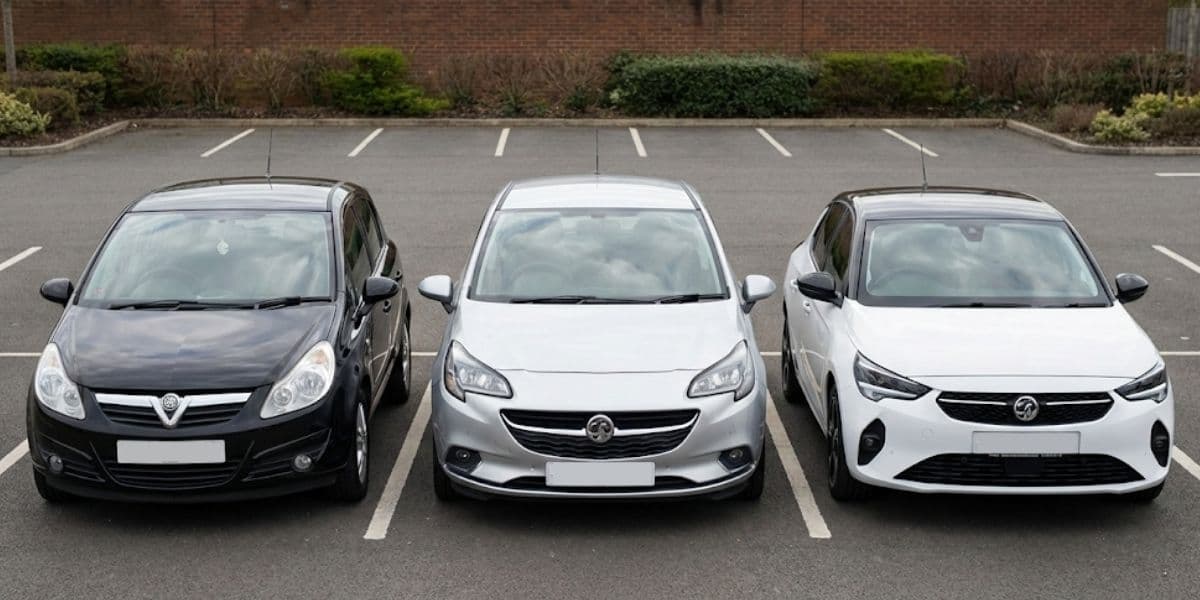
| Feature | Corsa D (2006-2014) | Corsa E (2014-2019) | Corsa F (2019-present) |
|---|---|---|---|
| Best engine for young drivers | 1.2 80bhp | 1.4 90bhp | 1.2 75bhp |
| Insurance groups (safe engines) | Group 1-3 | Group 3-8 | Group 10 |
| Used price range | £2,000-£5,000 | £3,500-£11,000 | £9,000-£18,000+ |
| Euro NCAP | 5 stars (2006 test) | 5 stars (2014 test) | 4 stars (2019 test) |
| Apple CarPlay | No | Late 2016+ IntelliLink only | Standard |
| AEB available | No | No | Standard |
| Key reliability risk | Timing chain stretch (1.0/1.2) | Coil pack failure (1.4) | PureTech wet belt (1.2 Turbo) |
| VED (road tax) | CO2-based (as low as £20/yr) | CO2-based (as low as £20/yr) | Flat rate £190/yr |
In short: The Corsa D is the cheapest to buy and insure but has the oldest tech and a known timing chain issue. The Corsa E is the sweet spot for most families: reliable, well equipped and affordable. The Corsa F is the most modern but more expensive to insure. The 1.2 Turbo PureTech engine carries a serious wet belt risk.
Driving and performance
The Corsa has never been the driver's car in the supermini class. That title belongs to the Ford Fiesta.
But the Corsa doesn't need to be exciting. For a new driver, the Corsa needs to be predictable, easy to park and not scary on the motorway. It does all three.
Corsa D (2006-2014)
The Corsa D feels its age from the driver's seat, but it's fine. Steering is light at low speeds and accurate enough for town driving. Body roll through corners is noticeable but never alarming. Motorway stability is as you'd expect. You'll notice wind noise above 60mph.
1.0 60bhp (the budget option):
- 0-62mph in 16.9 seconds
- Feels strained on motorway slip roads. Adequate for town, but plan your overtakes on A-roads.
- Real world fuel economy: 42-48mpg
- Insurance Group 1
- Timing chain stretch risk (see Known Issues)
1.2 80bhp (the recommended pick):
- 0-62mph in 14.2 seconds
- Noticeably more relaxed than the 1.0. Handles motorway driving without drama.
- Real world fuel economy: 40-45mpg
- Insurance Group 2-3
- Same timing chain risk as the 1.0, but a better balance of power and economy
1.4 90bhp (for confident drivers):
- 0-62mph in 12.3 seconds
- The most comfortable motorway cruiser in the Corsa D range
- Real world fuel economy: 38-42mpg
- Insurance Group 6-8 (noticeably higher)
- More reliable than the 1.0/1.2 (different timing setup)
Corsa E (2014-2019)
The Corsa E improved everything the Corsa D got wrong. The ride is smoother, the cabin is quieter. A new suspension setup dropped the centre of gravity for better stability. It's still no Fiesta through the corners, but the gap is smaller than it used to be.
1.4 90bhp (the recommended pick):
- 0-62mph in 12.3 seconds
- The most common Corsa E on the used market. A known quantity.
- Real world fuel economy: ~42mpg
- Insurance Group 6-8
- Occasional coil pack failure (cheap fix at ~£100 per coil)
1.0T Ecotec 115bhp (the fun one):
- 0-62mph in ~10 seconds
- Three-cylinder turbo with genuine punch from low revs. The standout engine in the Corsa E range.
- Real world fuel economy: ~50mpg
- Insurance Group ~10-12
- Smooth around town, strong enough for confident motorway overtaking
"The 1.0-litre petrol is the stand-out performer... it's smooth and quiet around town and powerful enough to keep up with fast-moving traffic."
That matches real world experience. The 1.0T is the Corsa engine that makes you understand why people like driving.
1.3 CDTi 95bhp diesel:
- Real world fuel economy: ~60mpg
- Makes financial sense only if your teen drives 15,000+ miles per year
- Insurance Group 7-9
- Check ULEZ compliance: pre-September 2015 Corsa E diesels may not meet Euro 6
Corsa F (2019-present)
A complete redesign on the Stellantis CMP platform. The Corsa F is lighter (up to 108kg less than the Corsa E), lower and more aerodynamic. It rides well on most surfaces, though some reviewers note the ride is firm on larger alloys.
1.2 75bhp (naturally aspirated, the safe pick):
- Basic entry-level engine
- Insurance Group 10
- Adequate for town driving, struggles a bit on motorways
- The only Corsa F petrol without the PureTech turbo wet belt concern
1.2 Turbo 100bhp (the common choice):
- 0-62mph in 9.9 seconds
- Punchy and refined for a small car
- Real world fuel economy: ~48mpg (WLTP: 52.3mpg)
- Insurance Group 12
- Reliability warning: PureTech wet belt issue (see Known Issues)
Corsa Electric (136bhp):
- 0-62mph in 8.2 seconds
- 246-mile WLTP range (expect 130-180 miles in winter)
- Insurance Group 24-25
- £195/year road tax from April 2025 (previously £0)
- Home charging: ~7.5 hours on a 7.4kW wallbox
""Vauxhall's fully-electric car is an excellent gateway to EVs."
Because it doesn't feel or drive differently from a petrol Corsa, this is true. But the insurance group (24-25) and purchase price (£9,000+ used) make it unrealistic for most first-car budgets. See our electric cars for young drivers guide for a full breakdown of EV costs.
Real world driving context
City driving: All three Corsa generations are easy to park. The Corsa D is 4,021mm long, the Corsa E is similar. The Corsa F is slightly shorter and wider. Light steering across all generations. Visibility is decent, though the Corsa E's thick A-pillars can block your view at roundabouts.
Motorway: The 1.0 Corsa D is uncomfortable at sustained motorway speeds. The engine sits at high revs and there's noticeable wind noise. The 1.2 Corsa D and any Corsa E engine are fine. The Corsa F is the most refined cruiser of the three, with less road noise and better high-speed stability.
For new drivers: The Corsa is predictable. It doesn't surprise you. That's exactly what you want when your teen is building confidence on the road. Electronic Stability Control is standard across all three generations.
Technology and interior
Corsa D (2006-2014)
Infotainment: CD player and basic Bluetooth on higher trims. No touchscreen, no smartphone integration. If your teen expects Apple CarPlay, the Corsa D isn't the right generation.
Interior quality: Functional but plasticky. Hard surfaces everywhere. The upside: these interiors are hard-wearing. A Corsa D with 80,000 miles will look tired but it won't be falling apart.
Driving position: Good seat adjustment range. The steering column adjusts for height but not reach on most trims, which can be an issue for taller drivers.
Corsa E (2014-2019)
Infotainment: 7-inch IntelliLink touchscreen with Apple CarPlay and Android Auto on models from late 2016 onwards. Earlier Corsa E models have a smaller screen without smartphone integration. The OnStar system (offering in-car WiFi and emergency response) was fitted to many Corsa E models, but the service was discontinued in 2020 and the hardware no longer functions.
Interior quality: A big step up from the Corsa D. Soft-touch materials on the dashboard, glossy trim pieces and a more cohesive design. Still not class-leading (the Renault Clio and VW Polo feel more premium) but a noticeable improvement.
Heated extras: Many mid-range Corsa E trims include heated seats and a heated steering wheel as standard. Useful through a British winter and a nice selling point for the used buyer.
One tip: If you're buying a Corsa E with a heated windscreen, check it works during the viewing. Replacement heated windscreens are expensive (£300-£500 fitted). Some owners have replaced them with non-heated glass to save money. You won't know unless you test it.
Corsa F (2019-present)
Infotainment: 7-inch or 10-inch touchscreen (post-2023 facelift) with Apple CarPlay and Android Auto as standard. The interface is responsive and the screen is clear in sunlight. Physical climate controls on most trims, which is a plus for reduced distraction.
Interior quality: The best Corsa interior by a wide margin. Softer materials, better fit and finish and a modern design. The digital instrument cluster (on higher trims) is crisp and configurable.
Boot space: 309 litres across the Corsa F range (petrol and electric). The Corsa E offers a similar figure. Neither is class-leading (the VW Polo manages 351 litres) but it's adequate for a weekly shop or a weekend bag.
Teen appeal
The Corsa F will impress mates with its modern dashboard and crisp screen. The Corsa D and E won't win any beauty contests inside. None of them have the driver focused feel of a Fiesta cockpit, but the Corsa F's tech is genuinely competitive with newer rivals.
Safety
Corsa D (2006-2014)
Euro NCAP (2006 test):
- Overall: 5 stars
- Adult occupant: 5 stars (29 out of 37 points)
- Child occupant: 3 stars
- Pedestrian: 3 stars (out of 4)
The 2006 test protocol is significantly less demanding than modern testing. A five star rating from 2006 is not equivalent to a five star rating from 2019. No AEB, no pedestrian detection, no cyclist detection. The Corsa D has six airbags and Electronic Stability Control as standard, which is the baseline for safe driving.
Standard safety features: Electronic Stability Control, six airbags, ABS with EBD, Hill Start Assist (later models).
Corsa E (2014-2019)
Euro NCAP (2014 test):
- Overall: 4 stars
- Adult occupant: 79%
- Child occupant: 77%
- Vulnerable road users: 71%
- Safety assist: 56%
The Corsa E improved the crash structure over the Corsa D but was tested under a more demanding protocol and achieved 4 stars in 2014. No AEB was offered on any Corsa E model. Electronic Stability Control and six airbags are standard.
The Corsa E lacks the active safety features that became standard on rivals like the VW Polo and SEAT Ibiza during this period. For parents, this is a consideration: if AEB is a priority, you need a Corsa F or a different car.
Corsa F (2019-present)
Euro NCAP (2019 test):
- Overall: 4 stars
- Adult occupant: 84%
- Child occupant: 86%
- Vulnerable road users: 63%
- Safety assist: 56%
The Corsa F scored 4 stars, not 5. The lower score in Safety Assist reflects the fact that the Lane Keep Assist system is basic compared to the VW Polo (5 stars, 2017 test). AEB is standard on all Corsa F models and works at speeds up to 50mph.
Standard safety features (all Corsa F): AEB, Electronic Stability Control, Lane Keep Assist, Speed Sign Recognition, six airbags, Tyre Pressure Monitoring.
Real world safety for new drivers
The Corsa's strongest safety asset isn't a crash test score. It's predictability. All three generations handle consistently in the wet. ESC intervenes cleanly if you overcook it. The car doesn't surprise you mid-corner. For a new driver who hasn't developed the instincts to correct a slide, that predictability matters more than most ADAS features.
For parents who want active safety tech, the Corsa F with standard AEB is the minimum. If budget forces you to a Corsa D or E, the car is still structurally safe in a crash, but it relies more on the driver's own awareness.
Parent peace of mind
The Corsa F gets an 8 with its standard AEB. The Corsa D and E get a 6 for structural safety without active tech.
Running costs and ownership
Insurance
| Engine Variant | Gen | Insurance Group | Est. Premium (17yo) | Est. Premium (21yo) |
|---|---|---|---|---|
| 1.0 60bhp (Expression) | Corsa D | 1 | £1,900 | £1,000 |
| 1.2 80bhp (Design) | Corsa D | 2-3 | £2,000 | £1,050 |
| 1.4 90bhp (SXi) | Corsa D | 6-8 | £2,200 | £1,200 |
| 1.4 90bhp (Design) | Corsa E | 6-8 | £2,200 | £1,200 |
| 1.0T 115bhp (SRi) | Corsa E | 10-12 | £2,450 | £1,400 |
| 1.2 75bhp (SE) | Corsa F | 10 | £2,400 | £1,350 |
| 1.2T 100bhp (Design) | Corsa F | 12 | £2,500 | £1,450 |
The Corsa D's Group 1 rating on the 1.0 is the lowest insurance group you can get on any car. Insurance experts explain the logic:
"Cars in lower groups are typically cheaper to insure... because these cars typically have less powerful engines, are known for being reliable, and repair costs tend to be lower."
For a 17 year old facing average UK premiums of £1,932, starting in Group 1 is a genuine financial advantage.
The Corsa E with the 1.4 90bhp sits in Groups 6-8, which is still affordable. This is the sweet spot: enough power for safe motorway driving without the insurance penalty of a turbo engine.
The Corsa F is more expensive to insure across the board. Even the base 1.2 75bhp sits in Group 10, roughly matching the 1.0 EcoBoost Fiesta. The jump from Corsa E insurance costs to Corsa F insurance costs is around £200-£300 per year for a 17 year old.
Fuel
| Engine | Real World MPG | Annual Cost (10,000 miles, £1.45/L) |
|---|---|---|
| 1.0 60bhp (Corsa D) | 42-48mpg | £1,580 |
| 1.2 80bhp (Corsa D) | 40-45mpg | £1,650 |
| 1.4 90bhp (Corsa E) | ~42mpg | £1,580 |
| 1.0T 115bhp (Corsa E) | ~50mpg | £1,320 |
| 1.2T 100bhp (Corsa F) | ~48mpg | £1,380 |
| Corsa Electric | 4.3 mi/kWh | ~£520 |
Tax (VED)
Corsa D and E (pre-April 2017 registration): Taxed on CO2 emissions. The 1.3 CDTi ecoFLEX qualifies for Band B at just £20/year. Petrol models range from £20-£150 depending on engine and year.
Corsa E (post-April 2017 registration) and all Corsa F: Flat rate £190/year for petrol models.
Servicing
| Item | Vauxhall Dealer | Independent Garage |
|---|---|---|
| Annual service | £170-£240 | £110-£170 |
| Major service (every 2 years) | £280-£380 | £180-£280 |
| Timing chain replacement (Corsa D 1.0/1.2) | £700 | £450-£600 |
| PureTech wet belt replacement (Corsa F) | £500-£700 | £350-£550 |
| Clutch replacement | £600-£900 | £350-£550 |
The Corsa is cheap to service. Parts are widely available and every independent garage in the country has worked on one. The 1.4 Corsa E is particularly straightforward: no timing chain concerns, no wet belt, no turbo. Standard maintenance only.
What to watch: known issues
Corsa D: timing chain stretch (1.0 and 1.2 petrol engines)
This is the most common and most expensive issue on the Corsa D. The 1.0 and 1.2 petrol engines use timing chains that stretch over time, particularly if oil changes have been skipped or cheap oil used.
What happens: The timing chain tensioner wears, causing the chain to become slack. A rattling noise on cold start is the telltale sign. If ignored, the chain can skip teeth or snap entirely, causing the pistons to hit the valves. That's a destroyed engine.
Repair cost: Around £700 at a Vauxhall dealer. Independent garages may charge £450-£600. That's manageable if you catch it early. If the chain snaps, you're looking at a replacement engine or scrapping the car.
What to check when viewing: Start the car from cold. Listen for a rattle from the engine bay in the first 10-15 seconds. If it rattles and then quiets down, the chain is stretching. Walk away or budget for the repair.
Corsa D: Easytronic gearbox (AVOID)
The Easytronic is an automated manual gearbox that uses a servo to operate the clutch and shift gears. It's jerky, slow and expensive to repair when the actuators fail (£500-£1,000). If you want an automatic, buy a different car entirely.
Corsa E: coil pack failure (1.4 engines)
The 1.4 and 1.4T engines can suffer from coil pack failures, causing misfiring and hesitancy under load. The good news: coil packs cost £30-£60 each and take an hour to replace. It's an annoyance, not a catastrophe.
Corsa F: PureTech 1.2 Turbo wet belt
This is the big one for the Corsa F. The 1.2 Turbo PureTech engine runs its timing belt inside the engine, bathed in oil. The same principle as the Ford EcoBoost wet belt. The same catastrophic risk.
What happens: Oil contamination causes the rubber belt to degrade and shed debris. That debris can block the oil pump strainer and the vacuum pump. A blocked vacuum pump means sudden loss of brake assistance. If the belt snaps, the engine is destroyed.
Critical maintenance:
- Oil changes every 12 months with manufacturer-approved low-acid oil
- Belt condition check at every oil change
- Belt replacement at 6 years or 60,000 miles (not the original 10 years/100,000 miles)
What to check when viewing (all generations)
- Full service history (especially oil changes every 12 months)
- Cold start test (listen for timing chain rattle on Corsa D 1.0/1.2)
- Easytronic check (if fitted, walk away)
- Steering at low speeds (should be light and smooth)
- Clutch feel (should bite halfway up pedal, no slipping)
A pre-purchase inspection from the AA or RAC costs around £200 and can save you thousands.
Reliability verdict
7/10 (Corsa E 1.4) | 6/10 (Corsa D 1.2 with service history) | 6/10 (Corsa F 1.2 Turbo)
The best variant to buy
Safe bet: 2016-2018 Corsa E 1.4 90bhp in Design trim
This is our top recommendation for most families.
Why:
- Engine: The 1.4 90bhp has no timing chain stretch risk and no wet belt. Coil packs are the main weakness. They're cheap to fix.
- Equipment: Design trim gets the IntelliLink touchscreen, air con, cruise control and heated front seats. Late 2016+ models include Apple CarPlay.
- Insurance: Group 6-8, keeping premiums manageable.
- Budget: £4,500-£7,500 (25,000-60,000 miles)
Budget conscious: 2012-2014 Corsa D 1.2 80bhp in Design trim
The best value option if budget is tight. For even more affordable options, see our best first cars under £3,000 guide.
Why:
- Engine: The 1.2 80bhp has the timing chain risk, but with verified service history and annual oil changes, many run past 100,000 miles without issue. Listen for the rattle and you'll know where you stand.
- Tax: Pre-April 2017, so VED can be as low as £30-£35/year.
- Insurance: Group 2-3. Among the cheapest cars in the UK to insure.
- Budget: £2,000-£4,000 (50,000-90,000 miles)
Something modern: 2020-2022 Corsa F 1.2 75bhp in SE or Design trim
The entry-level Corsa F avoids the PureTech wet belt.
Why:
- Engine: Naturally aspirated 1.2 avoids the wet belt issue affecting turbo models.
- Tech: Apple CarPlay, 7-inch touchscreen, standard AEB.
- Insurance: Group 10 (higher than Corsa E, but still reasonable).
- Budget: £9,000-£13,000 (15,000-40,000 miles)
Avoid
- Easytronic gearbox (any year, any engine)
- Corsa D 1.0/1.2 with no service history (timing chain could go at any time)
- Corsa D 1.6T VXR for a new driver (Group 30-34 insurance, 192bhp)
- Corsa F 1.2 Turbo with no evidence of oil change schedule (wet belt risk)
The verdict
Pros
- Insurance groups start at Group 1 (cheapest available)
- Massive used market with thousands of options
- Every garage in the UK knows how to service a Corsa
- Corsa E 1.4 is a proven, reliable engine with cheap maintenance
- Corsa F brings standard AEB and modern tech
- Pre-2017 models can qualify for VED as low as £20/year
Cons
- Not as engaging to drive as the Ford Fiesta
- Corsa D timing chain is a known and common failure point
- Corsa F PureTech wet belt carries a serious reliability risk
- Easytronic automated gearbox is unreliable (avoid entirely)
- Interior quality on the Corsa D is tired and dated
- Corsa F insurance groups are higher than expected
Final word: The Vauxhall Corsa is a good budget concious choice. It's not the most exciting car in the class, but excitement isn't what most families need from a first car. They need low insurance, cheap running costs, proven reliability and easy access to parts and service. The Corsa delivers all of that (depending on the specific model). The Ford Fiesta is a more fun car to drive, but the Corsa is the better car to buy when insurance groups and purchase prices are factored in. For a broader comparison, see our best first cars guide.
The key decision is which generation to buy. The Corsa D is the budget entry point but needs careful checking. The Corsa E is the sweet spot: old enough to be affordable, new enough to be well equipped. The Corsa F is the most polished car, but higher insurance and the PureTech wet belt issue take the shine off for families watching the budget.
2016-2018 Corsa E 1.4 Design. That's the one to buy.
For parents in or near ULEZ zones (London, Birmingham, Manchester), all Corsa F models and post-September 2015 Corsa E petrol models meet Euro 6 standards. Earlier Corsa D and E diesels will cost £12.50 per day in central London's ULEZ zone.