Insurance Group 1 Cars: Every Confirmed Model (2026)
Quick answer
Insurance group 1 cars are the cheapest cars to insure in the UK. Insurance groups run from 1 to 50, set by Thatcham Research on behalf of the Association of British Insurers, and Group 1 is the lowest risk rating available. Cars confirmed in Group 1 include the Volkswagen Up!, Hyundai i10, Kia Picanto, Skoda Fabia 1.0 MPI and Citroën C1. Drivers aged 17–21 insuring a Group 1 car typically pay between £1,100 and £1,850 per year with a telematics policy.
How UK car insurance groups work
Every car sold in the UK is assigned to one of 50 insurance groups by the Group Rating Panel, run by Thatcham Research on behalf of the Association of British Insurers (ABI) and Lloyd’s Market Association.
Group 1 is the lowest risk rating. Group 50 is reserved for the highest-performance, highest-value cars. For young drivers, the group number is one of the biggest fixed factors an insurer uses when pricing a policy.
Five things determine where a car lands:
- Damageability: How much it costs to repair after a standard low-speed crash test (15 km/h offset impact, front and rear). Cars with modular, bolt-on panels that absorb damage without deforming the main structure score better.
- Parts pricing: The cost of 23 standard replacement parts, including bumpers, headlamps and radiators. Mass-produced cars with widely available parts score lower.
- Engine performance: Group 1 cars typically take more than 13 seconds to reach 62 mph. Higher power-to-weight ratios push a car into a higher group.
- Safety technology: Cars with Autonomous Emergency Braking (AEB) fitted as standard earn lower ratings because they reduce low-speed rear-end accidents and the personal injury claims that follow. This is sometimes offset by the cost of repairing the front-mounted sensors when an impact happens that the AEB does not avoid.
- Security: Immobilisers, alarms and steering locks are assessed against Thatcham’s requirements for that vehicle class.
The letter after the number
Most insurance group ratings come with a suffix letter. This tells you how a specific car’s security compares to what Thatcham expects for its class.
| Suffix | Meaning | Effect on premium |
|---|---|---|
| E (Exceeds) | Security beats the standard for this class | Rating dropped by one or more groups |
| A (Acceptable) | Security meets the baseline | No change |
| D (Does not meet) | Security falls short of requirements | Rating raised to a higher group |
| U (Unacceptable) | Security is critically low | Insurers may require aftermarket upgrades |
| P (Provisional) | Full evaluation not yet complete | Rating subject to revision |
| G (Grey import) | Non-UK specification vehicle | Rated individually, outside standard groups |
When you see a car listed as Group 1E, that “E” means the car’s security exceeds what Thatcham expects for its class, which earns a one-group discount and is part of why it sits in Group 1 despite being a larger or better-equipped car than you would expect at this rating level.
Always check the specific trim and variant you are considering, not the model name in general. Trim, wheels and engine can all have an impact.
At a glance: confirmed Group 1 cars in the UK
| Car | Engine | 0–62 mph | Combined MPG | Used price range | Est. annual premium (age 17–21) |
|---|---|---|---|---|---|
| Volkswagen Up! 1.0 60 PS | 999 cc petrol | 14.4s | 62.8 mpg | £3,500–£8,500 | £1,200–£1,700 |
| SEAT Mii 1.0 60 PS | 999 cc petrol | 14.4s | 62.8 mpg | Similar to Up! | Similar to Up! |
| Skoda Citigo 1.0 60 PS | 999 cc petrol | 14.4s | 62.9 mpg | Similar to Up! | Similar to Up! |
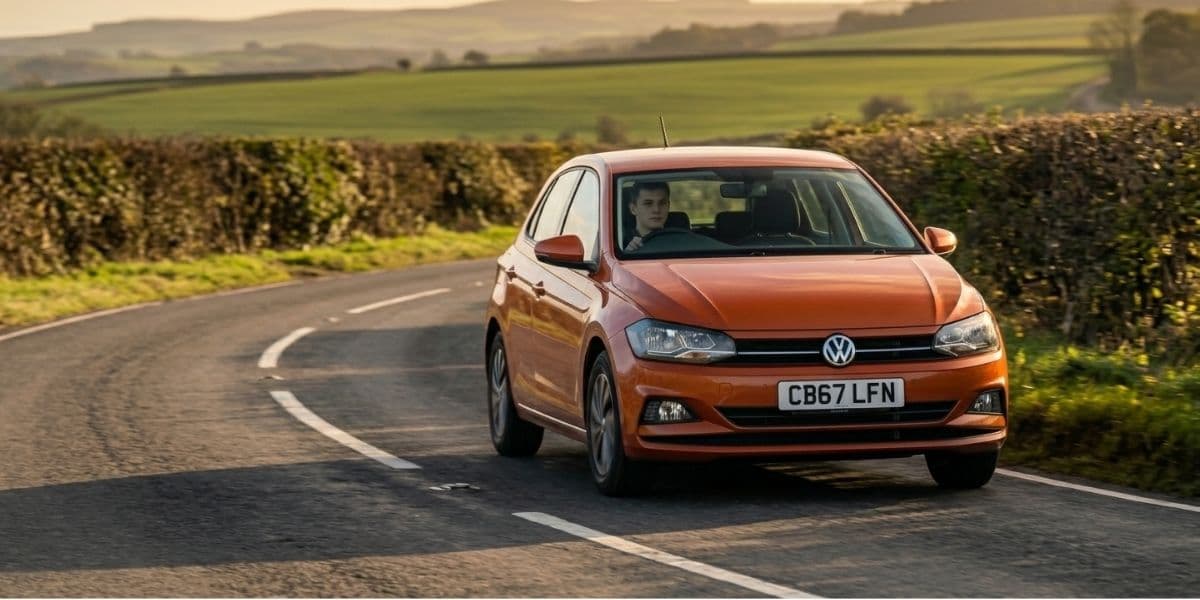
| Volkswagen Polo Mk6 1.0 MPI 65–80 PS | 999 cc petrol | 15.4s | 53.3–58.9 mpg | £7,000–£12,000 | £1,100–£1,500 |
| Skoda Fabia Mk3 1.0 MPI 60–75 PS | 999 cc petrol | 14.9–16.0s | 58.9 mpg | £4,500–£9,000 | £1,150–£1,550 |
| Hyundai i10 1.0 Blue Drive | 998 cc petrol | 14.8s | 56.5 mpg | £4,000–£9,500 | £1,200–£1,650 |
| Kia Picanto 1.0 | 998 cc petrol | 14.1s | 55.4 mpg | £8,500–£15,000 | £1,300–£1,800 |
| Kia Rio UB 1.1 CRDi | 1,120 cc diesel | 15.5s | 78.5–88.3 mpg | £2,500–£5,500 | £1,250–£1,750 |
| Citroën C1 1.0i | 998 cc petrol | 13.7s | 62.8 mpg | £1,500–£4,500 | £1,300–£1,800 |
| Vauxhall Corsa D 1.0 ecoFLEX | 998 cc petrol | 18.2s | 55.4 mpg | £1,500–£4,000 | £1,350–£1,850 |
| Ford Ka+ 1.2 Studio | 1,196 cc petrol | 15.3s | 56.5 mpg | £5,000–£7,000 | £1,100–£1,400 |
| Smart Forfour 1.0 71 PS | 999 cc petrol | 15.9s | 56.5 mpg | £4,000–£8,000 | £1,200–£1,700 |
Estimated premiums based on a 17–21 year old with a clean licence in an average UK postcode, insuring the car as the main user. Individual quotes vary a lot by postcode, occupation and driving history.
Why bigger cars are now in Group 1
Historically, Group 1 was the exclusive territory of tiny A-segment city cars (VW Up!, Kia Picanto etc): lightweight, low-powered, cheap to repair. Some B-segment cars (eg VW Polo, Skoda Fabia) are now able to get Group 1 as well.
The sixth-generation Volkswagen Polo Mk6 (2017 onwards) and third-generation Skoda Fabia Mk3 (2015–2021) have both secured Group 1 status in their lowest-power configurations. Both are larger B-segment superminis with a lot more interior space, bigger boots and better ride quality than a typical city car. So why do they share a Group 1 rating with the Citroën C1?
The answer could be in personal injury claims. Around half of all insurance payouts are linked to car damage repairs, but personal injury claims cost far more per incident to settle. A larger supermini with standard AEB is statistically less likely to generate a serious injury claim than a basic city car without it, even if the repair cost after an accident would be higher.
The right Polo or Fabia variant gets you a larger, more comfortable and premium feeling car at the same baseline insurance group as a basic city runabout. The safety record is better too.
The car-by-car breakdown
Volkswagen Up!, SEAT Mii and Skoda Citigo
These three share an identical mechanical package: a 999 cc naturally aspirated engine producing 60 PS and 95 Nm, a five-speed manual gearbox and a sedate 14.4-second 0–62 mph time. They are basically the same car from the NSF platform with different badges and minor trim details.
The Up! is the most popular of the three, maybe due to the reputation of the VW badge. Car reviewer Dan Prosser, writing for Car Magazine, described it as “one of the best small city cars of this era or any other, fun to drive, safe in an accident and surprisingly grown-up on the motorway.” The wheel-at-each-corner stance gives it a balanced, settled feel on country roads that many larger cars do not match. City Emergency Braking using a laser sensor is standard on most trim levels, which directly contributes to the Group 1 rating.
Watch out for
The five-speed ASG automated manual gearbox option on the Citigo is widely criticised for jerky, hesitant shifts. Choose the standard five-speed manual. Some owners also report water leaks caused by blocked drainage channels beneath the windscreen. Check the footwells for dampness when viewing any used example.
Verdict
The best-driving Group 1 city car. The VW build quality and standard safety tech make it a strong recommendation for urban use and light commuting.
Volkswagen Polo Mk6 and Skoda Fabia Mk3
These are the surprisingly big Group 1 cars. The Polo Mk6 offers a 351-litre boot and the Fabia Mk3 380 litres. Both are comfortably ahead of any city car option and competitive with many family hatches. Ride quality on both is noticeably better than city-car alternatives and motorway noise is well managed.
For Group 1 status, you need the little 999 cc MPI (naturally aspirated) engine. On the Polo, that means the 65 PS, 75 PS or 80 PS MPI variants. On the Fabia, the 60 PS or 75 PS MPI. The turbocharged 1.0 TSI versions of both models sit in higher groups. When you check the registration of any car you are considering, confirm it has the MPI badge rather than TSI.
The MPI engine in a Polo or Fabia is slow due to the weight and low power. The Polo weighs over 1,100 kg and the Fabia 1,086 kg. With 65 PS pulling it along, merging onto a dual carriageway requires planning. The 0–62 mph times of 15.4 seconds (Polo) and 16.0 seconds (Fabia 60 PS) are the slowest among the Group 1 superminis.
Watch out for
Urban fuel economy on the MPI engine is lower than the official combined figures suggest. The engine cannot lean on low-end torque and needs revs to produce pace. If the car will see a lot of short urban trips, the non-turbo engine will feel laboured.
Verdict
The best-space, best-ride option in Group 1. Good for a young driver who needs a car that can carry passengers and cover motorway miles, not just urban commutes.
Hyundai i10 and Kia Picanto
The Hyundai i10 (second generation 2014–2019, third generation 2020 onwards) and Kia Picanto (third generation 2017 onwards) share the Kappa II 998 cc engine. Both qualify for Group 1 in base manual configurations.
The i10 is noted for its practical and decent spec interior. Physical climate controls, a high roofline and proper rear headroom make it feel less constrained than its footprint suggests. Motoring journalist Rob Gill described the current generation as “a tidy little motor that would suit a 17-year-old as much as a 77-year-old.” The suspension is fine and the steering is light without being vague in typical urban driving.
One point worth noting on safety: the third-generation i10 received a three-star Euro NCAP rating, against the five-star results achieved by the Volkswagen group cars.
The Kia Picanto has bolder exterior styling and benefits from Kia’s seven-year manufacturer warranty, which transfers to subsequent owners for the remaining term on used examples. Before buying, check how many years of that warranty remain. The base suspension is stiffer than the i10’s over broken urban surfaces. Less noticeable on smooth A-roads, more apparent on potholed city streets.
Watch out for
Both the i10 and Picanto are available with a five-speed Automated Manual Transmission (AMT) in some configurations. In the i10, the AMT adds 3.6 seconds to the 0–62 mph time, taking it to 18.4 seconds. It is also known to hesitate in city traffic. The standard manual is the better choice if it’s an option for you.
Verdict
Reliable and practical city cars with a competitive running cost package. The i10’s lower Euro NCAP rating is worth weighing against the Picanto’s warranty advantage on the used market.
Kia Rio 1.1 CRDi: the diesel option
The Kia Rio UB 1.1 CRDi (2011–2017) is the only diesel engine in Group 1. It works differently from every other car on this list.
The 1,120 cc three-cylinder turbodiesel produces 75 PS and between 170–180 Nm of torque at 1,500 rpm. That low-end torque makes it effortless in traffic and comfortable at motorway speeds in a way that naturally aspirated petrol alternatives cannot match. Official combined fuel economy runs from 78.5 to 88.3 mpg depending on the variant and real-world figures on mixed routes come close to those numbers.
The ULEZ warning
The Rio 1.1 CRDi is Euro 5, which means it fails the Ultra Low Emission Zone criteria in London and is subject to daily charges in Clean Air Zones across other UK cities. The London ULEZ charge is £12.50 per day and Scottish clean air zones fines are brutal, doubling at each offence.
Diesel maintenance: The Diesel Particulate Filter (DPF) needs regular high-speed driving to regenerate. A driver who mainly covers short cold journeys of five miles or less will experience DPF blockages. The EGR valve also requires periodic attention. Dual-mass flywheel replacement is expensive on high-mileage examples. These are not exceptional problems for a diesel of this era, but they make the Rio diesel unsuitable for predominantly urban use.
Verdict
A capable option for young drivers on long-distance rural or commuter routes outside Clean Air Zones. Wrong choice for urban-only use and not suitable for London.
Budget options: Citroën C1 and Vauxhall Corsa D 1.0
Citroën C1 1.0i (2005–2014)
The C1 offers the cheapest entry point into Group 1, with used examples starting around £1,500. The standout advantage is the Toyota-sourced 1KR-FE engine, which uses a timing chain rather than a rubber cambelt and has a strong long-term reliability record. Routine service parts are cheap and widely available. You can find a basic Peugeot 107 in the same insurance group and it’s the same car with a different badge. Weirdly the Toyota equivalent Aygo isn’t available as Group 1.
Boot space is 139 litres, the smallest of any car on this list. Motorway driving is loud. The cabin is sparse. If the car will cover regular dual-carriageway distances or carry passengers regularly, the C1’s limitations will become apparent quickly.
Car reviewer Mat Watson of Carwow put it plainly: “With a cheap car like the C1, it’s easy to focus on how little it can cost. But you’ll get a much better car if you spend a little bit more.” That holds when comparing the C1 to mid-range options at the top of the Group 1 price range.
Watch out for
Corrosion on first-generation examples, particularly around wheel arches and sills. The 1KR-FE engine is reliable but neglected examples with poor service history can have cooling system issues.
Vauxhall Corsa D 1.0 ecoFLEX (2006–2014)
The Corsa D 1.0-litre produces the highest estimated premiums among Group 1 cars (£1,350–£1,850 for young drivers) and is also the slowest, at 18.2 seconds to 62 mph. The 998 cc engine is underpowered for the Corsa’s heavier chassis.
More importantly, the 1.0-litre Corsa D engine has known reliability weaknesses: premature timing chain stretch and ignition coil pack failures. These are not rare faults. When viewing any used example, confirm from the service history whether the timing chain and tensioner have been replaced. If the records do not show this work and the mileage is over 50,000 miles, budget for it.
The Corsa D 1.0 does feel more substantial than the smallest city cars and has a proper glovebox. If the car will be used on faster roads and the young driver finds A-segment city cars too cramped, it is a valid option. Go in with eyes open on the engine maintenance record.
Ford Ka+ 1.2 Studio (2016–2019)
The Ka+ is a B-segment car with a longer wheelbase than typical city car alternatives, which gives it comfortable passenger space front and rear. The 1,196 cc Sigma Duratec engine is a conventional naturally aspirated four-cylinder. Ford service costs are low and parts are widely available.
The base Studio trim is the only variant in Group 1. The steel front subframe is prone to rust in areas where road salt is used heavily. Check it carefully on northern UK examples. Standard equipment is minimal so don’t expect many extras.
Verdict on all three
The C1 beats the Corsa D 1.0 on reliability, running costs and performance. The Ka+ is worth considering for anyone who finds city cars too cramped but cannot stretch to Polo or Fabia pricing.
Which Group 1 car should you buy?
The right choice depends on how the car will actually be used.
- For motorway commuting and longer runs: The Volkswagen Polo Mk6 1.0 MPI or Skoda Fabia Mk3 1.0 MPI. Their larger wheelbase, better road noise insulation and more refined suspension make them comfortable at 70 mph. The lower insurance premium compared with higher-group superminis often justifies the higher purchase price. Check the total cost over three years, not just the sticker price.
- For city driving and parking: The Volkswagen Up! (or SEAT Mii or Skoda Citigo). Excellent build quality and a compact footprint. The most fun to drive in this group and the most pleasant for daily urban use.
- For the lowest possible running costs: The Citroën C1, provided the boot space and noise levels are acceptable. The Toyota-sourced engine’s reliability and the cheap running costs make it a strong budget option.
- For used market reliability assurance: The Kia Picanto where a remaining manufacturer warranty still applies. Confirm how many years remain before purchase. Any balance of Kia’s seven-year coverage is worth having.
- Avoid the Kia Rio diesel unless the car will cover a meaningful proportion of its miles at motorway speeds outside London and Clean Air Zones.
Getting more out of a Group 1 car
Choosing Group 1 establishes the lowest possible risk baseline. These steps extend the saving.
- Add telematics. A black box policy on a Group 1 is the cheapest way to insure a first car. Insurers use GPS and accelerometer data to monitor speed, cornering force and late-night driving. On a £1,500 base premium, that is a saving of £300–£600 in year one. Safe driving scores typically earn further reductions at renewal. Check the specific policy though, some are more restrictive than others.
- Check the security suffix. When verifying a car’s group on the ABI tool, note the suffix letter. A Group 1E car already earns the maximum security discount for its class. A Group 1D or 1U car has a shortfall, so factor that in.
- Avoid cosmetic modifications. Aftermarket alloy wheels, body kits and styling upgrades increase the car’s replacement value and theft attractiveness. Both push the effective risk profile up even within the same nominal group.
- Park off-street where possible. Overnight parking on a private driveway or in a locked garage reduces theft risk. Insurers factor parking location into premiums.
- Confirm the exact variant before committing. The 1.0 TSI Polo is not Group 1. The 1.0 MPI is. The Hyundai i10 AMT sits in a higher group than the manual. Always check the specific registration on the ABI Group Rating tool. A ten-second check avoids an expensive mistake.
The First Car Guide
Group 1 gives you the cheapest baseline. The Guide covers the rest: finding cars in the right insurance groups, what to check when you view one, and more. Free download.