Nissan Micra (2006-2026) Review for Young Drivers: Insurance, Running Costs and What to Watch
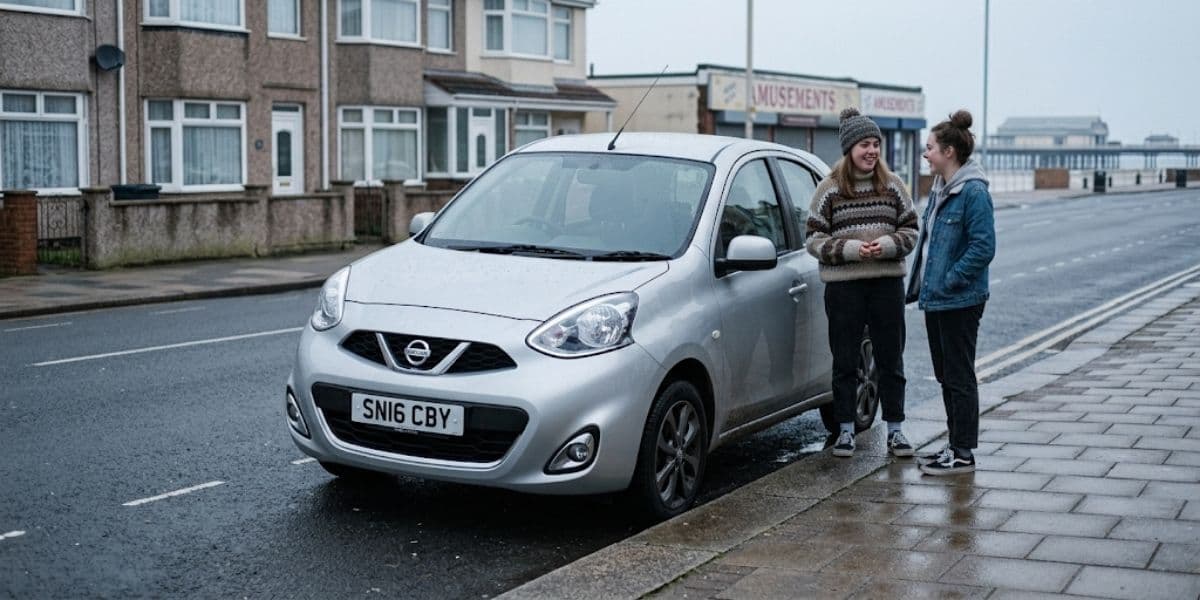
The wrap
The Nissan Micra is one of the most recognisable first cars in the UK, but the last 4 versions are completely different cars from one another. The 2006-2010 K12 is a futuristic looking cheap runaround with a timing chain risk. The 2010-2017 K13 is pretty ropey. The 2017-2023 K14 is a decent option for young drivers: low insurance, modern safety and Apple CarPlay. The 2025 K15 is a brand new electric Micra based on the Renault 5 that drives brilliantly but costs £23,000 and starts at insurance group 19.
Quick facts
| Metric | Value |
|---|---|
| Insurance groups | 1-22 (1-8 for young driver petrol engines) |
| Used price range | £1,500-£23,000 |
| Euro NCAP | 4 stars (K12: legacy), 4 stars (K13: 2011), 4-5 stars (K14: 2017), 4 stars (K15: 2024) |
| Best engine | 1.0 IG-T 100hp (K14, post-2019) |
| Annual running cost | £2,500-£4,000 estimated for a 17-18 year old |
Who is this car for?
The Micra suits a specific buyer, and the right answer depends almost entirely on which generation you pick.
Perfect for:
- Young drivers who want the lowest possible insurance group (the K14 1.0 71hp is group 1)
- Parents who want modern safety kit without paying for a new car (the K14 brought standard autonomous emergency braking)
- Teenagers doing mostly town and short commute driving
- Car buyers who have Apple CarPlay and Android Auto as a top priority (from K14)
Not ideal for:
- A cheap automatic (the K13 CVT is unreliable, avoid it)
- Buyers doing lots of motorway driving (the K14 1.0 71hp is slow)
- People working with a low budget (the older K12 timing chain issue can write off the engine / car)
The used market splits into four clear tiers. K12 (2006-2010) for £1,500-£3,000. K13 (2010-2017) for £3,000-£6,000. K14 (2017-2023) for £6,000-£12,000. K15 EV (2025 on) from £22,995 new. Each one is a different car with different things to check.
For another group 1 option, see our Toyota Aygo review.
The four generations: K12 vs K13 vs K14 vs K15
| Feature | K12 (2006-2010) | K13 (2010-2017) | K14 (2017-2023) | K15 EV (2025-) |
|---|---|---|---|---|
| Built in | Sunderland, UK | India / Thailand | France | France (Renault plant) |
| Best engine for young drivers | 1.2 80hp | 1.2 DIG-S 98hp | 1.0 IG-T 100hp | 40kWh electric |
| Insurance groups (safe engines) | 7-11 | 5-10 | 1-8 | 19-22 |
| Used price range | £1,500-£3,000 | £3,000-£6,000 | £6,000-£12,000 | £22,995 new |
| Euro NCAP | 4 stars (legacy) | 4 stars (2011) | 4 stars, or 5 with Safety+ Pack | 4 stars (2024) |
| Apple CarPlay | No | No | Acenta trim and above | Google Built-in |
| AEB available | No | No | Standard | Standard |
| Key reliability risk | Timing chain stretch | CVT and clutch failure | Verify two safety recalls | Brand new, high repair cost |
In short: the K12 is the cheapest way into a Micra but the tech is ancient and the timing chain needs proof of servicing. The K13 is cheap to run but was also built cheaply, with a clutch and gearbox that can cost more to fix than the car is worth. The K14 is a good option: it shares its bones with the Renault Clio, it's safe and it has good tech as standard. The K15 is an excellent electric car (re-skinned Renault 5) but it's outside first-car insurance territory.
For a cheaper-to-insure rival, see our Hyundai i10 review.
Driving and performance
K12 (2006-2010)
The K12 is light, easy to park and has a tight turning circle. The 1.2 petrol with 80hp is fine around town and nothing more. Push it onto a motorway and it runs out of puff, and real-world economy of around 41mpg is poor for such a small car. It does the job of a cheap trainer car and little else. My wife had one of these as her second ever car and didn't like it.
K13 (2010-2017)
This is the generation the driving press disliked. Mat Watson at Carwow noted the light steering and tight 9.3m turning circle make town parking effortless, but on a country road the steering goes vague, the front end loses grip and the body rolls. The three cylinder engine gets noisy and unrefined when you ask it to accelerate, and that's worse again with the CVT automatic. The supercharged DIG-S with 98hp is the pick if you want a bit more pace and 54mpg.
K14 (2017-2023)
The K14 is a big step forward as it became based on the Renault Clio. Nissan tuned the chassis and steering on UK roads, so it deals with rough, broken surfaces well.
"The new Nissan Micra casts away the dreary image of predecessors to become a top supermini."
The engine you pick makes a big difference here. The cheap 1.0 71hp takes 16.4 seconds to reach 62mph and feels outgunned the moment you leave town. The 0.9 turbo has an awkward flat spot low down before the turbo wakes up. The post-2019 1.0 IG-T 100hp fixed that flat spot and is the one to have.
K15 EV (2025-present)
The electric Micra is the most fun to drive of the lot. A low centre of gravity, multi-link rear suspension and instant electric torque make it good fun to drive.
"There are few small cars I enjoy chucking into corners as much as the Micra."
The trade-off is a firm ride on its standard 18 inch wheels, which thump over sharp potholes.
Real-world driving context
For a new driver, the K14 1.0 IG-T 100 is the version that gives you a safe reserve of power for merging and overtaking without a big jump in insurance. Avoid the K14 1.0 71hp if there's any regular dual carriageway or motorway in the mix. It's safe, but working a slow engine hard to keep up with traffic is stressful for a nervous driver and it kills the fuel economy.
Technology and interior
K12 (2006-2010)
Basic. A CD player and an FM radio, plus clever sliding rear seats that lets you trade boot space for rear legroom. There's no screen and no phone connectivity, so factor in the cost of an aftermarket stereo if your teen wants CarPlay.
K13 (2010-2017)
Still sparse on lower trims. Top-spec Tekna models get an early NissanConnect system with SD-card maps, but it drops Bluetooth connections often enough to be annoying. The 265 litre boot is a fair size and the tall roofline gives good rear headroom, though the dashboard plastics feel cheap and scratchy.
K14 (2017-2023)
This is where the Micra got modern. Acenta trim and above gets a responsive seven inch touchscreen with wired Apple CarPlay and Android Auto, which is the single biggest reason to choose this generation. The 300 litre boot is bigger than the K13. The catch is the sloping roofline cuts rear headroom for taller passengers and the thick A-pillars create a blind spot at junctions that new drivers should be aware of.
K15 EV (2025-present)
A big leap again. A standard 10.1 inch screen with Google Built-in means Google Maps and apps run natively without your phone. The 326 litre boot is the biggest of any Micra. Rear space is tight though, so the back seats are best for kids or shorter trips, and there's no front boot for the charging cables.
Safety
K12 (2006-2010)
A four star Euro NCAP rating under the old testing rules. You get ABS and dual front airbags, with side airbags only on higher trims. Electronic stability control was optional or trim-dependent rather than standard, so check the spec. It's solid for its age but lacks the structural strength and electronics of anything newer.
K13 (2010-2017)
Better on paper. Six airbags and electronic stability control became standard, and it scored four stars under the tougher 2011 rules. The lightweight body (around 910kg) showed some weakness in high-speed frontal tests, which is the downside of building a car this light and this cheap.
K14 (2017-2023)
This is the safety highlight of the range. Every K14 left the factory with autonomous emergency braking and lane departure warning as standard, which is rare at this price. There's an important detail for buyers: the standard car scored four stars, but cars fitted with the optional Safety+ Pack (standard on the flagship Tekna) scored the full five stars. That pack adds pedestrian and cyclist detection to the AEB. If you can find a K14 with Safety+, you're getting strong protection.
K15 EV (2025-present)
Four stars under the strict 2024 rules, with 80% for both adult and child protection. Standard kit includes radar and camera AEB, emergency lane keeping, blind spot monitoring and a fatigue sensor. Two things to know: Euro NCAP rated driver and rear chest protection as marginal in some tests, and there's no child presence detection, plus it can't take a standard rear-centre child seat.
Real-world safety for new drivers
If safety is the priority and the budget stretches to it, a K14 with the Safety+ Pack is a decent shout. Standard autonomous emergency braking is the feature that prevents the low-speed shunts new drivers are most likely to have. The K12 and K13 have none of this, so you're relying on the driver alone.
Running costs and ownership
Insurance
Insurance is the biggest cost for a young driver, and the Micra spans a wide range of insurance groups depending on engine.
- K14 1.0 71hp: group 1, the lowest rating in the UK. Cheapest to insure, but slow.
- K14 0.9 IG-T: groups 3-5.
- K14 1.0 IG-T 100: groups 5-8. The best balance of insurance and usable pace.
- K13 1.2: groups 5-10.
- K12 1.2: groups 7-11. Higher than you'd expect for an old, cheap car.
- K15 EV: groups 19-22. The repair cost of EV parts and instant torque push it well up the scale.
The takeaway: the K14 petrol cars are cheaper to insure than the older K12, even though they're newer and worth more. That's the opposite of what you'd expect from an older, cheaper car, and it's a strong argument for skipping straight to the K14.
Fuel
Real-world economy from Honest John's tracked data:
- K12 1.2: around 41mpg
- K13 1.2: around 46mpg, or 54mpg for the DIG-S
- K14 1.0 71hp: around 50mpg
- K14 1.0 IG-T 100: around 45mpg
- K15 EV: around 4.0 miles per kWh, roughly 170 miles of real range from the 40kWh battery
Tax (VED)
- K12 and pre-2017 K13: based on CO2 emissions, from as little as £20 a year for the DIG-S up to around £200 for the K12.
- K14 (registered after April 2017): flat rate, currently £195 a year.
- K15 EV: electric cars lost their tax exemption in April 2025, so the standard £195 rate now applies.
The older, higher-emitting K12 and K13 are also the ones to check against city charging schemes. See our low emission zones guide for young drivers.
Servicing
The K14 benefits from sharing parts with the Renault Clio, so independent garage servicing is cheap and easy. Budget £150-£250 for a basic service. The K12 and K13 are simple and cheap to fix too. The K15 EV removes oil changes, clutches and timing chains entirely, which cuts routine servicing, but bodywork and battery repairs are specialist and expensive.
Annual running cost summary
A realistic estimate for a 17-18 year old running a K14 1.0 IG-T 100, doing around 7,000 miles a year, lands at roughly £2,500-£4,000 all in. Insurance is by far the biggest slice of that. The figure drops noticeably for a 21 year old or anyone who can go on a parent's policy as a named driver, as long as the young driver is the main user (insuring it the other way round is fronting, and that's fraud).
What to watch: known issues
K12: timing chain stretch
The 1.2 and 1.4 petrol engines can suffer timing chain stretch, often caused by skipped oil changes starving the chain tensioner. It starts as a metallic rattle on cold start and can end in terminal engine failure. Replacement runs £1,000-£1,400, which is more than many K12s are worth. On a test drive, listen hard on a cold start. If you hear a rattle, walk away.
K12: throttle body and power steering
The K12 also has weak throttle bodies that usually need full replacement rather than a clean, and the electric power steering motor can fail suddenly, which means an instant loss of steering assistance. Check the steering feels consistent throughout a test drive.
K13: clutch and CVT failure
Manual K13s are known for early clutch wear, sometimes inside 10,000-25,000 miles, showing up as a high biting point or slipping. A replacement is £500-£700. Worse, the Jatco CVT automatic can fail completely if its fluid changes are skipped, and a replacement gearbox can top £2,300. Avoid the CVT automatic entirely and check any manual carefully for clutch slip.
K13: suspension and air con
Front lower arm bushes and drop links wear out by around 40,000 miles, giving a knocking sound over bumps. Air conditioning leaks can also flood the passenger footwell and short out wiring, so check the carpets are dry.
K14: verify the recalls
The K14 is the most reliable of the petrol cars, but two safety recalls must have been done. One covers an ignition switch wiring connector that could cut the engine while driving, the other covers passenger airbag wiring. Get the registration checked against Nissan's recall records before you buy. Also avoid the 1.5 dCi diesel for short town trips, as it clogs its particulate filter.
What to check when viewing (all generations)
- Full service history, especially oil changes on the K12
- Cold start with no rattle (K12 timing chain)
- Clutch biting point and any slip on K13 manuals
- Dry footwell carpets on the K13
- Recall work confirmed as done on the K14
- For the K15 EV, ask for a battery health check
The best variant to buy
The best all-rounder: 2019-2022 K14 1.0 IG-T 100 in Acenta trim
Insurance group 5-8, the post-2019 engine with no flat spot and Apple CarPlay as standard. Look for one with the Safety+ Pack for the five star crash rating. Priced at £7,000-£11,000.
Lowest insurance: 2017-2019 K14 1.0 71hp in Acenta trim
Group 1 is as cheap as UK insurance gets. Accept that it's slow and best kept to town and short commutes. Priced at £6,000-£8,500.
Budget choice: 2012-2014 K13 1.2 DIG-S in a manual
Cheap to tax and run at 54mpg, and the supercharged engine has a bit more oomph than the standard 1.2. Insist on a manual and check the clutch. Priced at £3,000-£5,000.
Ultra-budget trainer: post-2006 K12 1.2 manual
A cheap first car for a low-mileage learner where total spend has to stay under £3,000. Only buy one with a documented oil change history and no cold-start rattle.
Parent-funded electric: K15 EV 40kWh Engage or Advance
A forward-looking choice if you have home charging and the budget. Get an insurance quote in the young driver's name before you place a deposit, as group 19-22 makes a big difference. For the wider picture, read our guide to electric cars for young drivers.
Avoid
- The K13 CVT automatic
- The K14 1.5 dCi diesel for short trips
- Any K12 with a rattle on cold start
The verdict
The Micra is a completely different car from generation to generation, so a single verdict doesn't fit. As a lineage, it earns 3.5 out of 5 because the generations are so uneven. Buy the right one and it's a good first car. Buy the wrong one and you're likely to get stuck with expensive repairs.
Pros
- The K14 offers group 1 insurance and standard autonomous emergency braking, a rare combination
- Cheap and easy to service, especially the Clio-based K14
- Apple CarPlay and Android Auto from the K14 Acenta up
- The K15 EV is good to drive if the budget stretches
Cons
- The K13 has expensive clutch and CVT failures
- The K12 timing chain can write off the engine
- The cheapest K14 engine is slow on the motorway
- The electric K15 is too expensive to insure on a typical young driver's budget
If you want one clear recommendation: skip the older cars and buy a post-2019 K14 1.0 IG-T 100 in Acenta trim, ideally with the Safety+ Pack. It's the version that does everything a first car needs to.