Hyundai i10 Insurance Groups: A Parent's Guide (2026)
The short answer
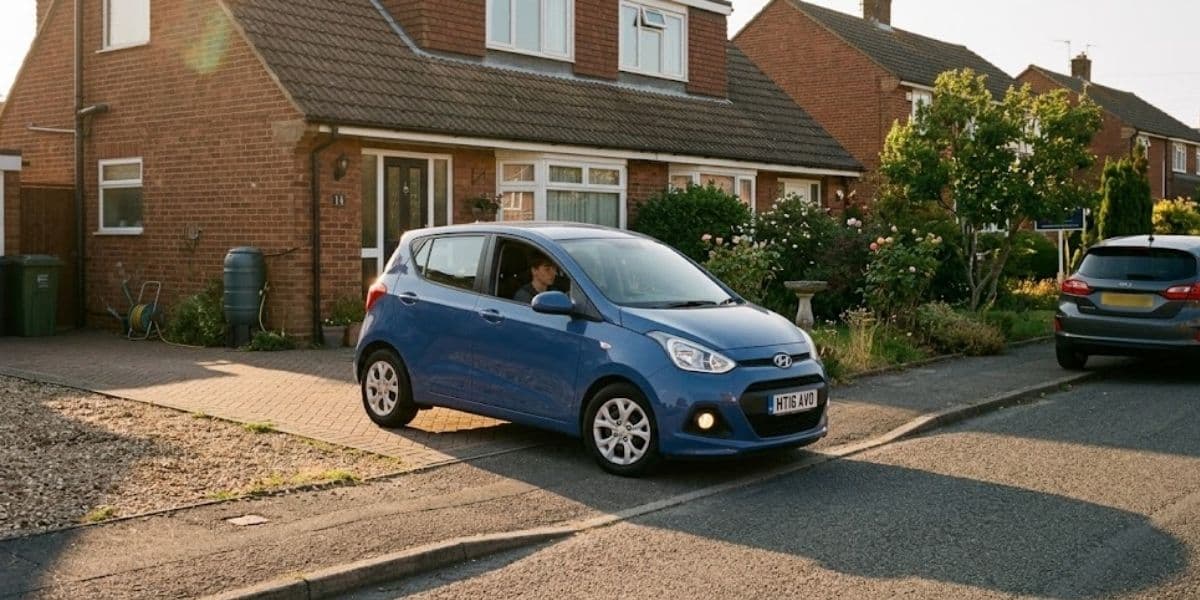
The Hyundai i10 is simple and cheap small car with low insurance groups, popular with young drivers. Unfortunately, this popularity has bumped up the premiums. It's a 'popularity paradox' victim. Mk2 (2014-2020) 1.0-litre variants in S, SE or Premium trim are in insurance group 1 or 2. Mk3 (2020-2026) variants run from group 3 to 10. Insurers' algorithms have learned that "young driver + i10" is a high-claim event. Quotes for a 17 year old on a group 1 Mk2 can be over £2k with telematics.
Best buy for the lowest premium: a 2016-2018 Mk2 1.0 (66PS) Premium. Group 2 with climate control, alloys and a good sound system.
Best all-rounder: a Mk3 1.0 MPi Advance (group 5) with Forward Collision-Avoidance Assist, Lane Follow Assist and Apple CarPlay as standard. Modern safety tech without the EV repair-cost penalty.
Avoid every Mk1 1.2-litre. The Comfort, Style and Active trims are in insurance group 11-12 and you could be looking at £3,000+ for a 17 year old with a black box.
Insurance quirks for the Hyundai i10
The i10 has a few insurance quirks that shape every quote on this model.
- Engine: A Mk1 1.2 (group 10-12) is up to eight groups higher than a Mk2 1.2 (group 4-7).
- Automated Manual Transmission: The Mk3 1.0 SE Connect with AMT is group 3, one group below the standard manual SE (group 4).
- Small engine/high spec: the Mk2 1.0 Premium stays in group 2 despite climate control, alloys and a touchscreen.
- The Mk3 safety: a three-star Euro NCAP rating with a 'Don't Buy' warning from Which? in 2020. It still has low insurance groups.
- No electrification. The i10 is one of the last pure-petrol UK city cars (no MHEV, no full hybrid). Repair routes use a standard mechanic and a standard radiator, not a high-voltage technician. That keeps the rating low.
- Popularity paradox. The i10 is a default first car alongside the Picanto, Aygo and C1, so the model has accumulated a high claim profile. A group 1 Mk2 routinely quotes £2,500-£3,000 for a 17 year old despite the rock-bottom rating.
Mk1 (2008-2013)
The Mk1 (2008-2013) is the generation that's cheapest to buy and usually most expsneive to insure. Insurance groups span from 9 (1.0 Blue, 1.1 Edition) to 12 (1.2 Active).
Repairability is one of the factors driving the costs.
There's no cheapest-tier (group 1-5) Mk1 i10. Quotes for a 17-19 year old on a group 11 Mk1 1.2 frequently exceed the entire asset value of the car.
Don't be tempted by the cheap Mk1 1.2 listings.
A 2011 i10 1.2 Active looks like a brilliant first car until the insurance quote comes back. Forum threads on r/LearnerDriverUK and PistonHeads document algorithmic rejections from mainstream insurers and quotes of £4,000-£7,000 on Mk1 1.2 variants for newly qualified 17-19 year olds, even with telematics offered. It might not be quite so bad now, since premiums have dropped a bit recently.
Mid-range insurance(Groups 6–10)
Insurance groups 6-10. Still affordable for a young driver, especially with an experienced named driver on the policy.
1.0 Petrol — Blue
Group 9Eco-focused trim with stop-start. The most insurable Mk1, but still two tiers above any Mk2 1.0.
1.1 Petrol — Edition
Group 9Special-edition trim on the larger 1.1 engine. Group 9 baseline. Outdated crash structure keeps it well above the Mk2.
1.2 Petrol — Classic
Group 10Entry point to the 1.2-litre Mk1. Group 10 is the floor. Every other 1.2 trim sits higher.
More expensive to insure(Groups 11–20)
Insurance groups 11-20. Not recommended as a first car. Premiums for under 25s typically run £3,000+ a year.
- 1.2 Petrol — Group 11 (Comfort (Manual / Auto)) — Mid Mk1 trim. Group 11. Real-world quotes routinely clear £3,500 a year for a 17-19 year old.
- 1.2 Petrol — Group 11 (Style) — Higher-spec trim with alloys and air-con. No security uplift, no Thatcham discount. Skip.
- 1.2 Petrol — Group 12 (Active (Manual / Auto)) — Top Mk1 1.2 trim. Group 12. Forum quotes for under-21s sit £4,000-£7,000. The classic false economy buy.
Mk2 (2014-2020)
The Mk2 (2014-2020) is where the i10 starts to make sense for young drivers as insurance groups are a lot lower. They span 1 (1.0 S/SE/Premium) to 7 (1.2 Premium SE). No variant in the Mk2 lineup pushes past group 7.
The pick is the 1.0 (66PS) in S, SE or Premium trim, in group 1 or 2. The Premium has climate control, alloys, upgraded audio, without any trim-level insurance penalty. The actuarial models read the engine and the bumper repair cost; the Premium badge doesn't move the needle. For a parent buying for a 17-19 year old, a 2016-2018 1.0 Premium with a full Hyundai service history is the strongest single Mk2 buy.
Stepping up to the 1.2 (87PS) earns the driver a bit more pace and the kind of motorway capability the 1.0 doesn't quite have. The cost is two to six insurance groups depending on trim. The 1.2 SE manual sits in group 5. Still relatively cheap for a 17-19 year old.
The Mk2 has no entries in the expensive (11-20) or very expensive (21+) bands. There is no GTI, N Line or performance variant to avoid. Every variant in this generation is, in principle, insurable for a young driver.
Two specific Mk2 dynamics worth flagging.
First: the popularity paradox lives here too. Even on a group 1 1.0 S, quotes for a 17-19 year old in a typical UK postcode have been £2k+ with a black box.
Second: the 1.2-litre Auto trims. Premium SE in automatic is group 7 and the four-speed automatic gearbox itself adds repair complexity that the manual avoids. If the young driver doesn't actively need an auto, the manual is two groups cheaper for almost identical equipment.
Cheapest to insure(Groups 1–5)
Insurance groups 1-5. The cheapest tier on the road for a young driver. Look here first.
1.0 (66PS) Petrol — S / S Air / SE / SE Blue
Group 1Group 1, the absolute floor on UK roads. Slow but mechanically simple and dirt cheap to repair after a kerb shunt.
1.0 (66PS) Petrol — Premium
Group 2The sleeper pick. Climate control, alloys, better infotainment, no trim-level premium penalty. Looks expensive, insures like a base S.
1.2 (87PS) Petrol — SE (Manual)
Group 5Top of the cheapest tier. The 1.2 SE manual sneaks into group 5. Extra torque without the premium-trim jump.
Mid-range insurance(Groups 6–10)
Insurance groups 6-10. Still affordable for a young driver, especially with an experienced named driver on the policy.
1.2 (87PS) Petrol — Premium
Group 7Same engine as the 1.2 SE, two groups higher for the trim. Marginal benefit, real cost.
1.2 (87PS) Petrol — Premium SE (Auto)
Group 7Auto box adds repair complexity. Group 7. The most expensive Mk2 still insurable for a young driver.
Mk3 (2020-2026)
The Mk3 (2020-2026) is more expensive to buy but often cheaper to insure. Insurance groups here span 3 (1.0 SE Connect AMT) to 10 (1.0 T-GDi N Line). The Mk3 is also the i10 generation that brought standard Forward Collision-Avoidance Assist with pedestrian and cyclist detection, Lane Follow Assist and Intelligent Speed Limit Assist on Advance trim and above. These ADAS systems are heavily weighted by Thatcham and bring the group down.
The 1.0 MPi (67PS) range is a good shout for a young driver, insurance groups are between 3 and 5 depending on trim. The top spec is the Advance at group 5, with standard 8-inch touchscreen, Apple CarPlay, rear parking sensors and a bunch of active safety features.
The 1.2 MPi (79-84PS) has more power with the same trim levels so insurance groups are a bit higher than the 1.0 equivalents. Unless your driver is doing a lot of motorway miles you're as well sticking with the 1.0 and get a cheaper premium.
The sporties model in the range is the 1.0 T-GDi (90PS) N Line. Turbo, 16-inch alloys, twin exhaust, triple-blade LED daytime running lights, sports interior. It's a luke warm rather than hot hatch, hence insurance group 10.
Two things to know about the Mk3.
First: the Euro NCAP rating. In late 2020, Euro NCAP gave the Mk3 i10 three stars and Which? issued a "Don't Buy" warning. The cited issues were submarining in frontal offset crashes (the driver sliding under the lap belt) and inadequate chest protection. If safety is a priority, maybe look at the VW Up! and their siblings.
The insurance group didn't move. The Mk3 stayed at group 3-5 because Thatcham weights low-speed bumper repairability heavily and i10 bumpers cost almost nothing to replace. So the premium stays cheap, but the cheap premium is funded by cheap bumper plastics, not by top-tier occupant protection.
If passive safety is the priority over the absolute cheapest quote, the Mk2 is mechanically similar and avoids the test result. A Volkswagen Polo Mk6 (94% adult occupant protection, five stars) is a good safety pick and is a bit bigger.
Second: the 1.2 SE Connect at group 8 is the worst-value Mk3 variant. It sits in the mid tier without the kerb appeal of the N Line or the standard ADAS suite of Advance. If you find yourself looking at one, check the 1.2 Advance (group 6) on the same forecourt. Same engine, two groups cheaper, more standard equipment.
Hyundai discontinued the i10 in the UK in 2026 to free up production capacity for its expanding EV lineup. Used Mk3 supply will tighten over the next 12-18 months.
Cheapest to insure(Groups 1–5)
Insurance groups 1-5. The cheapest tier on the road for a young driver. Look here first.
1.0 MPi (67PS) Petrol — SE Connect (AMT Auto)
Group 3The AMT inversion. Automated manual gearbox sits one group below the standard manual SE because the buyer pool is older and calmer.
1.0 MPi (67PS) Petrol — SE
Group 4Manual base trim. Group 4 with Forward Collision-Avoidance Assist and Lane Follow Assist as standard.
1.0 MPi (67PS) Petrol — Advance
Group 5Replaces the SE Connect manual. 8-inch touchscreen, Apple CarPlay, parking sensors. Group 5 is the all-rounder pick.
Mid-range insurance(Groups 6–10)
Insurance groups 6-10. Still affordable for a young driver, especially with an experienced named driver on the policy.
1.2 MPi (79-84PS) Petrol — Advance
Group 6The 1.2 jumps one group over the 1.0 Advance for the extra torque. Worth it if your driver does motorway miles.
1.2 MPi (84PS) Petrol — Premium
Group 7Top petrol trim short of N Line. Heated seats, climate control, larger alloys. Group 7.
1.0 T-GDi (90PS) Petrol — N Line
Group 10Turbo. 16-inch alloys, twin exhaust, body kit. Group 10 for what looks like a hot hatch. The actuarial bargain of the segment.
Still considering a Hyundai i10? Read the full review before you buy →
Frequently asked questions
Is the Hyundai i10 cheap to insure for a 17 year old?
Depends on the generation and trim, but generally, yes. They have low insurance groups but are affected by the popularity paradox so might be pricier to insure than other low insurance group but less popular cars.
Which Hyundai i10 variants should young drivers avoid?
Avoid Mk1 (2008-2013) 1.2-litre trim. Classic, Comfort, Style and Active all sit in group 10-12, and real-world quotes for a 17-19 year old commonly run £3,000-£7,000 a year, well above the asset value of the car. The classic false-economy buy. Second: the Mk3 1.2 SE Connect (group 8). It sits in the mid tier without the standard ADAS suite of the Advance trim, so you pay the higher premium without the safety upside. The 1.2 Advance (group 6) is mechanically identical with more equipment. Third: any 1.2-litre Auto Mk2 if a manual will do. The auto adds two groups for the four-speed gearbox repair complexity. For absolute lowest premium, stick to the Mk2 1.0 (66PS) S, SE or Premium (group 1-2) or the Mk3 1.0 MPi SE Connect AMT (group 3).
Why is the Mk1 Hyundai i10 1.2 so expensive to insure when it's so cheap to buy?
This is the engine paradox. A 2010 Mk1 1.2 Active sits in group 12. A 2016 Mk2 1.2 SE manual sits in group 5. Same displacement, similar power output, six insurance groups apart. The cause is Thatcham's repair methodology. The Mk2 architecture was designed for cheap, fast bumper-and-panel replacement after low-speed urban knocks, which Thatcham weights heavily in the group rating. The Mk1 was not. Components on the older car cost more to source, panel alignment after a 15 mph hit takes longer, and the lack of active safety tech means no Thatcham discount is applied. Combine the group 11 or 12 baseline with a 17 year old's age multiplier and a typical postcode, and the resulting quote routinely runs two or three times the value of the car. The newer Mk2 ends up substantially cheaper to own across the first year, even after the higher purchase price.
Is the Hyundai i10 N Line worth insuring as a young driver's first car?
If your kid likes it and you have a decent insurance quote. It's a low insurance group for a relatively quick city car with sporty look. The Mk3 1.0 T-GDi (90PS) N Line is a turbocharged, twin-exhaust, 16-inch-alloy, body-kitted city car that sits in insurance group 10. Expect £1,800+ with telematics for a 17-20 year old.
Should I worry about the Mk3 i10's three-star Euro NCAP safety rating?
It's worth bearing in mind that the testing standards go up with time, so it's still relatively safe compared to olders cars. That said, for peace of mind it might be worth picking a different make and model altoegher. A Volkswagen Polo Mk6 (94% adult occupant protection, five stars) is a bigger car and a stronger safety pick, though it costs more to buy and runs into the same popularity paradox on the insurance quote. The i10 remains a sensible first car. It just isn't the safest choice in the segment.
Is the Hyundai i10 cheaper to insure than a Kia Picanto or Toyota Aygo?
Roughly equivalent. All three sit on the same actuarial floor (group 1-5 for the cheapest variants) and all three suffer the same popularity paradox. The Picanto shares much of its mechanical platform with the i10 and tends to quote within £50-£150 of the equivalent i10 trim. The Aygo (and its C1/108 platform siblings) often comes out £100-£200 cheaper on real quotes because the buyer pool is slightly less dominated by 17-19 year olds.
Want help finding the right Hyundai i10?
Tell us your budget and postcode.
We'll match you with vetted dealers and the right models for your young driver.
Other models to consider
I'm Iain. I started carbi after seeing firsthand the hassle that families go through to put a teenager on the road in a safe and insurable car. More on the about page.