Why Young Drivers Crash: Understanding the Teen Brain (2026 UK Guide)
The key fact
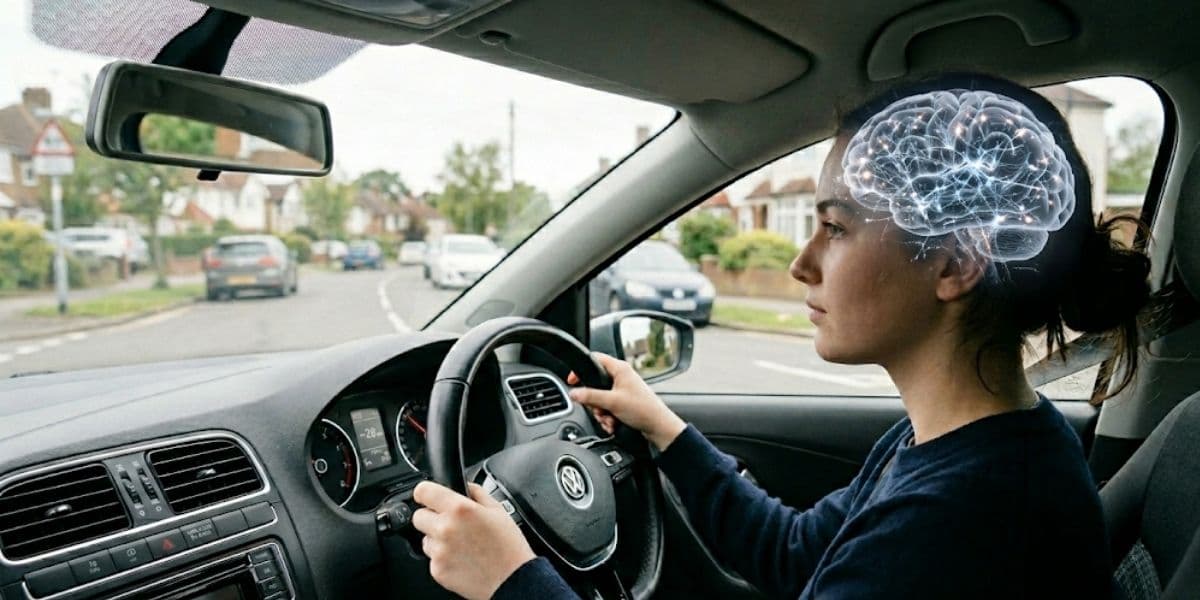
Young drivers aged 17 to 24 are four times more likely to be killed or seriously injured on UK roads than all drivers over 25. You might think it's inexperience (and some of it is – I remember my driving instructor telling me "the confidence will come before the experience"). The more nuanced explanation is neurobiology. The pre-frontal cortex is the brain region responsible for risk assessment, impulse control and decision making. It doesn't fully mature until the mid-to-late twenties. This guide covers what that means behind the wheel and what parents can do before the keys are handed over.
The pre-frontal cortex: what it does and when it's ready
The pre-frontal cortex (PFC) sits at the front of the brain, just behind the forehead. It's the executive control centre for every decision made on the road.
Its core functions include weighing up risk and consequence (accurately projecting what happens if you overtake on a blind bend), inhibitory control (suppressing the urge to check a phone notification), working memory and multitasking (holding the speedometer, the cyclist in the mirror and the approaching junction in mind at once while holding a conversation) and emotional regulation (overriding anger or excitement with rational judgment).
None of this is optional when driving. Every junction, merge, decision about speed relies on this part of the brain working well.
The problem is timing. The PFC is the last region of the brain to develop. It doesn't reach full maturity until somewhere between 23 and 27. A 17 year old can pass a driving test and operate the controls with more physical precision than a 45 year old. Their PFC is still under construction.
Sarah-Jayne Blakemore, Professor of Cognitive Neuroscience at University College London, explains the consequence:
"The last part of the brain to develop is the pre-frontal cortex, which is the part that weighs up risk and consequence, forms judgments and controls impulses and emotions. This means it can be much harder for teenagers to think ahead and make sensible decisions."
This is not a character defect. It's a stage of human development. Knowing it changes how parents should approach the entire first-year driving period.
The reward system fires before the brakes can kick in
The PFC doesn't mature in isolation. While it develops slowly, another brain system is going in the opposite direction.
The limbic system, particularly a structure called the nucleus accumbens, is highly active during adolescence. It processes emotions and evaluates rewards. In teenagers, it's hypersensitive. Imaging studies comparing brain activity across age groups show that adolescents register medium and large rewards with far greater neural activity than either children or adults.
This creates a mismatch. The reward seeking system runs hot. The system that applies the brakes, assesses consequences and overrides impulses is not yet up to full capacity.
"This combination of factors is what leads many teenagers to take greater risks than adults, because they're seeking a buzz to satisfy that reward centre, while their pre-frontal cortex can't register all the risks these actions involve."
A teenager who runs a yellow light isn't necessarily being reckless. Their brain may be registering the decision as rewarding while underweighting the consequence. The neurological infrastructure for fully appreciating the risk isn't in place yet.
Four ways this affects driving
Working memory and cognitive overload
Working memory is the ability to hold multiple pieces of information in mind and act on them simultaneously. In driving terms, it's what allows you to track a cyclist in the mirror, watch for a changing light ahead and stay under the speed limit all at once.
Research from the Annenberg Public Policy Center and the Children's Hospital of Philadelphia tracked young people from age 10 to 20, measuring working memory development against driving outcomes. Adolescents with slower working memory development had higher rates of crashes and traffic citations. In simulator tests, those with lower working memory showed poorer hazard detection and worse lane discipline.
A busy roundabout at rush hour may be close to the cognitive ceiling for a new driver. Add a chatty friend in the passenger seat plus finding a Spotify playlist and you're over it.
Impaired risk assessment
The PFC works out consequences. Overtaking on a blind bend needs the ability to vividly model what happens if an oncoming car appears. An underdeveloped PFC struggles with this kind of abstract future modelling. I remember some very sketchy driving situations when I was young – luckily I made it to late 20s unharmed.
A University of Turku study used fMRI to scan the brains of risk-prone teens during a simulated driving game. Participants chose whether to accelerate through yellow lights or stop. The study found that brain structures processing reward matured faster than structures involved in planning ahead. The accelerator developed before the brakes, neurologically speaking.
Interestingly, the teens who took the most risks showed signs of more advanced brain maturation in some areas. Just not in the areas governing long-term consequence evaluation.
Distraction sensitivity
The PFC controls the ability to filter out irrelevant stimuli. A phone notification, a roadside hoarding, a song change: older adults suppress these automatically. For teenagers, the suppression mechanism is weaker. Each distraction competes more effectively for attention.
"Ineffective observation by the driver" was cited in 24% of young driver fatal and serious collisions in 2024, according to Department for Transport data.
Emotional dysregulation
Without a fully functional PFC, frustration escalates faster and the urge to respond to a perceived slight on the road is harder to override. UK collision data shows young drivers are twice as likely as older drivers to be assigned the factor of "aggressive, dangerous or reckless" driving in fatal and serious crashes: 24% compared to 12% for older drivers.
The passenger effect: why friends make it worse
This is one of the most important findings in road safety research and isn't well understood.
When a teenager drives alone or with an adult, their accident rate is statistically the same as an adult driver. The moment a same age peer gets in the passenger seat, the risk profile shoots up.
It's not only social pressure. It's also neurological.
fMRI studies show that the mere presence of a peer increases blood flow to the ventral striatum, the brain's reward centre. When a friend is watching, risky behaviour like running a yellow light or pushing the speed limit feels neurologically more rewarding. The limbic system goes up a gear without the passenger saying a word.
"Adolescents aren't stupid. Rationally, they already understand the risks... Often, their decisions are driven by the fear of exclusion by their friends, rather than by a dispassionate consideration of the consequences."
The parental presence produces the exact opposite effect. Research by psychology professor Eva Telzer at the University of Illinois showed that a mother's presence measurably blunts the activation of the adolescent's reward centre when they're contemplating a risky decision. Teens driving with a parent are far less likely to take risks and neurologically register safe behaviour as more rewarding when observed.
A parent in the passenger seat is providing an external version of the missing brain infrastructure.
The UK statistics
The neuroscience shows up in the crash data.
In 2024, young drivers aged 17 to 24 were involved in crashes that killed or seriously injured 4,740 people on Great Britain's roads. Around a fifth of all killed or seriously injured casualties in car crashes involved a young driver, despite young drivers holding a small fraction of total licences.
The breakdown: 1,376 were the young drivers themselves. 1,003 were passengers travelling with young drivers. 2,360 were other road users: pedestrians, cyclists and occupants of other cars.
Young driver crashes don't only affect young drivers.
| Casualty type in collisions involving younger drivers (2024) | Share of total KSI |
|---|---|
| The young driver | 29% |
| Passengers of young drivers | 21% |
| Other road users (pedestrians, cyclists, other drivers) | 50% |
Source: Department for Transport, Reported road casualties Great Britain, younger driver factsheet 2024
Rural roads present the highest risk. Between 2020 and 2024, 49% of young driver KSI casualties occurred on rural roads, compared to 42% for older drivers. Rural roads demand the most from a driver cognitively: national speed limits, narrow lanes, blind bends and unpredictable hazards. They place maximum pressure on exactly the brain systems that are still developing.
36% of young driver KSI casualties in 2024 involved a single car losing control without another car being present. That points directly to speed management failures and insufficient hazard anticipation. Both are pre-frontal cortex functions.
21.6% of new drivers are involved in an accident in their first year of driving. For 18 to 24 year olds specifically, that climbs to 26.1% (Zego Insurance, 2026).
Time of day concentrates the risk further. 46% of young passenger casualties occurred at weekends. 37% happened between 11pm and 6am.
What parents can do
The pre-frontal cortex can't be accelerated into maturity. Parents can compensate for the gap though.
"When parents are effectively equipped and engaged, they can have a sustained, positive and measurable influence on young driver risk far beyond the supervised learning phase."
Write a driving agreement before handing over the keys
A formal, written parent-teen driving agreement is one of the most effective tools available. The adolescent brain tests ambiguous limits. A clear written contract removes the ambiguity and sets consequences before emotions run high.
The evidence is specific: 90% of teens with a driving agreement wear seatbelts consistently, compared to 53% of those without one. 91% of teens with an agreement rarely or never text while driving, compared to 61% without one.
The agreement should cover: passenger restrictions (limit to one peer in the first year, ideally none initially), night driving restrictions (the 11pm to 6am window accounts for 37% of young passenger KSI casualties), mandatory telematics and zero tolerance for alcohol or drugs. Spell out who covers fuel, insurance premiums and any excess in the event of a claim. Financial skin in the game instils realism without a lecture.
Use commentary driving during supervised practice
Commentary driving is an instructional technique where the driver verbalises their observations in real time. "Approaching junction, light is green, checking mirrors, cyclist on the left, easing off the gas, junction clear."
It works because it forces the young pre-frontal cortex to systematically process visual information. Verbalising the environment anchors attention and prevents the mental drift that causes hazard misses. For the supervising parent, it provides immediate feedback on what the young driver is and isn't seeing. If they don't say it, they haven't registered it. That's the point at which to intervene verbally, before it becomes an emergency stop.
Vicki Butler-Henderson, motoring journalist and presenter, advises cementing three foundational physical habits early: keeping hands in the "quarter to three" position, lifting the eyes to look further down the road than feels natural and doing all braking in a straight line before bends and roundabouts. These habits, once automatic, reduce cognitive load measurably in complex situations.
Keep supervising well beyond the test
The DVSA practical test is a threshold, not a milestone. Passing it means minimum competence in controlled conditions. The neural pathways that make hazard perception automatic take longer to form.
The first year after passing is the most dangerous. In that year, young drivers are covering new roads independently, often at night, often with peers, without the scaffolding of structured lessons. That's exactly when sustained parental involvement matters.
Keep a supervised driving log. Introduce new environments (motorways, rural A-roads at speed, night driving) while you're still in the passenger seat. Don't remove that layer until there's evidence of confidence and consistency.
Choose a car that reduces cognitive load
Car choice has a direct bearing on how much cognitive demand is placed on a new driver. Every extra piece of complexity the car needs is working memory taken away from hazard perception. Touchscreens have made this worse in recent years.
Automatic gearboxes reduce cognitive load by removing gear management from the task entirely. EVs fit this well. They have instant, predictable responses and no clutch. But the instant torque demands careful speed discipline. Read the full guide to EVs for young drivers
Look for cars in insurance groups 1 to 5 with modern ADAS features (if your budget stretches to it): automatic emergency braking, lane-keeping assist and speed sign recognition. These aren't gimmicks. They provide a second layer of intervention for exactly the reaction-time and attention failures that an immature PFC is prone to.
Cars worth considering on this basis:
- Vauxhall Corsa review for young drivers
- Ford Fiesta review for young drivers
- Toyota Yaris review for young drivers
- VW Up review for young drivers
- Renault Clio review for young drivers
Telematics: a pre-frontal cortex helper
A black box insurance policy does more than reduce premiums. It provides the immediate, concrete feedback loop that an underdeveloped PFC can't generate internally.
The adolescent brain struggles with abstract, long-term consequences. "If I speed, I might crash in six months" doesn't resonate neurologically. "If I brake harshly today, my app score drops into the red and my premium goes up next month" does. The immediacy of the feedback is what makes it effective.
Telematics devices monitor speed, acceleration, harsh braking, cornering forces and time of day. That data feeds into a smartphone app with a live score. The result is a gamified, reward based feedback loop that directly engages the adolescent's hypersensitive reward system. Safe driving becomes something the brain can register as rewarding in real time.
"Telematics can help drivers build safer habits, receive feedback on their driving and access services that support them on the road."
The UK Financial Ombudsman Service logged over 1,200 complaints from under-25 drivers about telematics policies in 2025. Most centred on unexpected cancellations, premium increases and scoring disputes. The policy terms require careful reading.
Pitfalls to know about: night driving penalties (many policies score harshly between 11pm and 6am, which is a problem if your teen has a part-time job), policy cancellations during university terms when the car sits idle for months, undeclared modifications that void the policy and fronting. Fronting is putting yourself as the main driver when your teen is the primary user. It's insurance fraud. It invalidates the policy and can result in criminal prosecution.
Full breakdown of how car insurance groups work
Post-test training worth considering
Passing the test is the start, not the end. Three structured post-test options exist in the UK:
Pass Plus is a minimum six-hour practical course covering motorways, night driving, all-weather conditions and rural roads. It costs around £150 to £300. Some local councils subsidise it and it often qualifies the driver for a small insurance discount.
IAM RoadSmart offers a Young Driver Assessment and a full advanced driving course, typically around £200. Up to 20% insurance discounts are available with specific brokers for IAM-qualified drivers.
RoSPA Advanced Driving is the highest civilian standard in the UK, with graded tests at Bronze, Silver and Gold levels. The test costs around £65. Drivers are re-tested periodically, which makes the standard meaningful.
"Of the 15% of drivers who are in their teens and 20s, 34% are involved in injury crashes."
Post-test training is one of the few interventions proven to move that number.
What's changing: graduated driver licensing in the UK
Graduated Driver Licensing (GDL) schemes restrict high-risk driving conditions for new drivers during the period when the brain is still developing. The standard components are peer passenger limits, night driving bans and stricter alcohol rules during a probationary period after passing the test.
Northern Ireland has confirmed a full GDL scheme launching on 1 October 2026. It includes a revised training framework with a mandatory logbook, passenger restrictions for newly qualified drivers and stricter penalties for early infractions.
"The fundamental goal of learning to drive and the licensing process should be to create drivers and motorcyclists who are safe and not just technically competent, by the time they are permitted to drive or ride unsupervised."
Great Britain (the UK minus Northern Ireland) currently has no equivalent legislation. The Department for Transport is consulting on minimum learning periods and other measures, but nothing is confirmed for implementation.
Until that changes, the responsibility for graduated restrictions falls on parents. The data makes the case for taking that seriously.
The First Car Guide
If you're starting to think about getting a car for your teenage, the Guide covers the practical next steps: understanding insurance, budgeting, what to check when you view one and how to get insured.
Free download.