Hyundai i10 review for young drivers
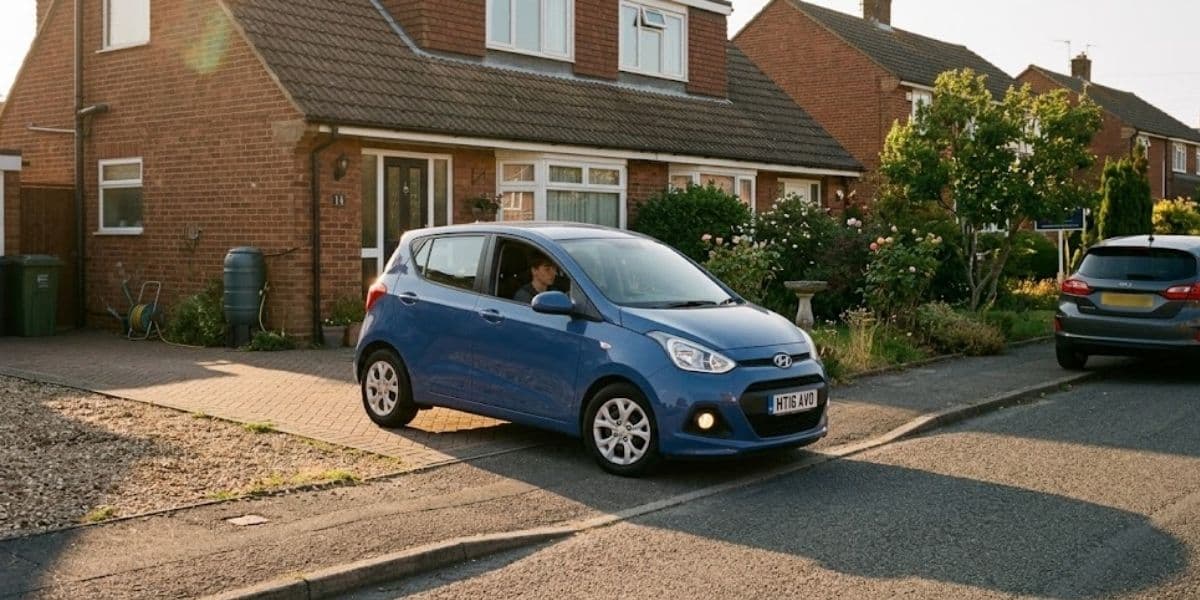
The wrap
Hyundai stopped making the i10 for the UK in early 2026, closing the book on 18 years and 370,000 UK sales. There are loads available on the used market. The Hyundai i10 sits in Insurance Groups 1–6, has a timing chain rather than a timing belt (no expensive replacement bill every 60,000 miles) and is compact enough to park easily. Read on to find the pros and cons of the generation and engine variants.
Quick facts
| Metric | Value |
|---|---|
| Insurance Groups | Groups 1–6 (engine and trim dependent) |
| Used Price Range | £3,000–£8,000 (Mk2); £11,300–£18,000+ (Mk3) |
| Euro NCAP | 3 stars (Mk3, 2020 test); not rated (Mk1/Mk2) |
| Best Engine | 1.2L for mixed or motorway use |
| Annual Road Tax | £0–£30 (pre-April 2017); £195 flat (post-April 2017) |
| Boot Space | 252 litres |
| Insurance (with black box) | £986–£1,633 (17–19 year olds) |
Who is this car for?
The Hyundai i10 is built for city life and it suits a newly passed 17 to 19 year old who does mostly short journeys. The 252-litre boot is quite big and the cabin seats four adults comfortably, which is unusual in a car this size. The steering is light and the car has good visibility, which helps build confidence with new drivers.
Perfect for:
- City driving, parking and short commutes
- Lowest possible insurance group (Group 1 on the 1.0L)
- Parents wanting predictable, low running costs
Not ideal for:
- Regular motorway driving (especially in the 1.0-litre)
- Drivers who want an engaging, fun driving experience
- Budget-conscious buyers looking at the Mk3 (£11,000+)
Driving and performance
In town, the Hyundai i10 is excellent. The electric power steering needs only 2.64 turns lock-to-lock, giving the i10 a turning circle of 9.72 metres. Parking is easy thanks to the upright seating position and large glass area.
On faster roads, the i10's character depends entirely on which engine is under the bonnet.
The 1.0-litre engine
The Hyundai i10's 1.0-litre three-cylinder produces 63–68 hp and the official 0–60 mph time is 15.6 seconds for the manual, 18.4 seconds for the automated version. It's slow, so merging onto a dual carriageway or a fast A-road requires commitment and a heavy right foot.
"Holy shit I'm going to die on this slip road."
That's an extreme reaction, but the underlying concern is legitimate. At motorway speeds the little three-cylinder is working hard and you hear it. As Honest John put it, the 1.0-litre i10 "whines on the motorway like a huffy teenager."
The 1.2-litre engine
The Hyundai i10's 1.2-litre four-cylinder produces 79–87 hp depending on the generation. The i10 1.2L sits at 70 mph comfortably, has enough mid-range power to merge safely and runs more quietly at speed. Real-world fuel economy between the two engines is much the same during mixed driving, the 1.0L has to rev harder to maintain speed, which cancels out its theoretical efficiency advantage.
The 1.2L sits in Groups 3–6 for insurance depending on the trim, rather than Group 1. That difference in insurance premium is worth it for the safety margin on motorways and rural A-roads.
"130k miles seems starship miles to me for a car that would traditionally do well under 10k a year."
The i10's 1.2-litre engine is built to last, but most used examples will have modest mileage. The Hyundai i10 is popular among older drivers who, as one r/AskUK user noted, "have cash to buy them new, do 20 miles a week in them," which means clean, low-mileage deceased-spec examples regularly appear on the used market.
Technology and interior
The inside of the Hyundai i10 is basic and simple. Hard wearing plastics, a simple layout and physical dials for the climate controls rather than a distracting touchscreen touchscreen.
Mk1 (2008–2013)
Basic AM/FM radio and CD player. No smartphone connectivity from the factory. Aftermarket Android or Apple CarPlay units can be fitted.
Mk2 post-2016 facelift (Premium SE trim)
The 2016 refresh brought a 7-inch touchscreen with Apple CarPlay and Android Auto as standard on Premium SE models. Hyundai also included a seven-year subscription to LIVE Services for real-time traffic. This was ahead of what you'd expect in an A-segment car at the time and it still does the job well.
Mk3 (2020–2026)
This generation has an 8-inch touchscreen standard across the range, a 4.2-inch digital instrument cluster and wireless charging available on higher trims. The most modern interior in the city car class when the Mk3 launched. Worth it if the budget stretches, but the price point makes it hard to justify as a budget first car.
The three generations: Mk1 vs Mk2 vs Mk3

| Feature | Mk1 (2008–2013) | Mk2 (2014–2019) | Mk3 (2020–2026) |
|---|---|---|---|
| Engine options | 1.0L, 1.2L | 1.0L, 1.2L | 1.0L, 1.2L, 1.0L Turbo |
| Insurance group | Group 1–3 | Group 1–6 | Group 1–6 |
| Infotainment | CD/Radio | 7" touchscreen (post-2016) | 8" touchscreen (standard) |
| Apple CarPlay | No | Yes (Premium SE, post-2016) | Yes (all trims) |
| Active safety | ABS, dual airbags | Optional LDWS, FCWS | Standard FCA, LFA |
| Euro NCAP | Not rated | Not rated | 3 stars (2020) |
| Used price range | £400–£5,000 | £3,000–£8,000 | £11,300–£18,000+ |
Safety
Mk1 (2008–2013)
The Mk1 Hyundai i10 is structurally solid, gets ABS and dual front airbags.
Mk2 (2014–2019)
The Mk2 Hyundai i10 added optional forward collision warning and lane departure warning via the Driver Assist Pack on post-2016 facelifted models.
Mk3 (2020–2026)
The Mk3 introduced a lot of active safety features. Forward Collision-Avoidance Assist (tuned specifically for pedestrian and cyclist detection) and Lane Following Assist are standard across the range. Euro NCAP gave the Mk3 Hyundai i10 three stars in 2020 testing. It's solid but not the five stars you'd get from a Volkswagen Polo or Ford Fiesta of the same era.
Running costs and ownership
This is where the Hyundai i10 stands out.
Insurance
The i10 1.0-litre sits in Group 1, the lowest possible rating on the ABI's 1–50 scale. Even the 1.2-litre tops out at Group 6. With a black box policy, first-year quotes for 17–19 year olds land between £986 and £1,633. Without a black box, expect £2,427–£2,542 for the same driver in the same car. The black box is pretty much mandatory in year one.
For context, the same driver in a Ford Fiesta (Groups 2–6) or Vauxhall Corsa can expect higher premiums, because data shows higher accident frequency among young drivers in those models.
Road tax
For Hyundai i10s registered before April 2017, road tax is calculated on CO2 emissions. Pre-2017 i10s pay £0–£30 a year. For cars registered on or after April 1, 2017, a flat rate of £195 applies regardless of engine size.
| Registration | VED System | Annual Cost |
|---|---|---|
| Pre-April 2017 (1.0L Blue) | CO2 emissions (Band A) | £0 |
| Pre-April 2017 (1.0L standard) | CO2 emissions (Band B/C) | £20–£30 |
| Post-April 2017 (Late Mk2 & Mk3) | Flat rate | £195 |
Fuel economy
Typical UK driving gets low-to-mid 50s mpg for most Hyundai i10 models. The Mk3's WLTP figure is 49.6–55.4 mpg, which is realistic for mixed use.
Servicing
The i10 is simple mechanically and straightforward to service. It has a timing chain so avoids the most expensive scheduled maintenance item cars with belts need every 60,000 miles.
"No time consuming costly change required in a few years time."
Clutch replacement averages £280. Brake pads cost about £153 per axle.
What to watch: known issues
The Hyundai i10 is reliable, but has its faults. These are the specific things to check before buying.
Clutch judder
A persistent problem on Mk1 and Mk2 Hyundai i10 manuals. It shows up as a violent shudder through the car when pulling away from a standstill, caused by premature wear on the clutch friction plate. Hyundai issued updated replacement parts during the production run, but high-mileage examples still suffer. Test it by pulling away slowly from cold on a flat road. Any shuddering is a red flag.
Gearbox crunching
Worn synchroniser rings cause a grinding noise when engaging reverse or when downshifting at low speeds. The repair is expensive )one owner was quoted £600 just for the diagnostic strip-down before any repair work was priced). Engage reverse from a standstill on your test drive. If it crunches, walk away.
Rear brake pad sticking
The Mk2 Hyundai i10's rear brake pads have a high iron content. Leave the car sitting in damp conditions and the pads can rust and bond to the disc surface. When you pull away, the adhesion breaks with a loud bang. Repeated over time, this warps the discs and damages the caliper sliding pins. Ask when the rear brakes were last inspected.
Headlight leveling motor failure
The manual headlight adjuster motor can fail internally and attempt to move continuously, producing a constant electrical whine inside the cabin. Not dangerous, but it's annoying.
Rust
Check the leading edge of the front bumper, the boot lid edges and beneath the rubber door strips on the rear doors. Cosmetic rather than structural, but it affects resale value and suggests the Hyundai i10 has been neglected.
Mk3 software glitches
The Mk3 Hyundai i10's 8-inch infotainment system has been reported with software bugs and, in some cases it can drain the battery, causing no-start issues. A software reset typically fixes it, but worth asking the seller about.
The best variant to buy
Best overall: 2016–2017 Mk2, Premium SE trim, 1.2-litre engine
The 2016 facelift brought CarPlay and Android Auto to the Hyundai i10 Mk2. Cars registered before April 2017 pay £20–£30 road tax rather than the £195 flat rate. The 1.2-litre handles motorway driving safely and sits in Groups 3–6 for insurance. Premium SE gives you the 7-inch touchscreen, the Driver Assist Pack with forward collision and lane departure warnings and alloys.
Budget concious: Late Mk1 1.2-litre
If the budget is under £3,500, a late Mk1 Hyundai i10 1.2-litre in good condition is worth considering. You lose the connected infotainment, but the mechanicals are solid and insurance is Group 1. Factor in the cost of a decent aftermarket head unit if phone connectivity matters.
Avoid
- Mk3 if budget is under £11,000
- Any automated manual transmission (AMT) Mk3, the gear change hesitation is a real problem in traffic
- Early torque-converter automatics on Mk1 and Mk2. They are mechanically robust but push up fuel consumption and CO2 emissions, moving them into higher VED bands
The verdict
The Hyundai i10 is a decent first-car option. Group 1 insurance, mechanically simple, a practical cabin and plenty of used-market stock to be choosy about condition. The Mk2 delivers modern smartphone connectivity at sensible money, typically £4,500–£7,500 for a well-maintained example.
TThe 1.0-litre is underpowered on motorways, the manual gearbox needs checking carefully on any higher-mileage examples and the automatic options aren't great.
Pros
- Insurance Groups 1–6, among the lowest of any car on the UK market
- Compact footprint with a practical interior that fits four adults
- Pre-April 2017 models pay £0–£30 road tax
- Strong used market supply after 370,000 UK sales
- Solid mechanical reputation when properly maintained
Cons
- 1.0-litre is underpowered for motorway use and feels strained under load
- Clutch judder and gearbox crunching are real risks on high-mileage examples
- Rear brake pad sticking is a known issue worth checking on every test drive
- Mk3 is expensive
Buy it if your teenager drives mostly in town, you want the lowest insurance group possible and you can find a clean 2016–2017 Mk2 Hyundai i10 with full service history.
Look elsewhere if it'll be used a lont on motorway journeys, you need an automatic or you want a bigger car.